Creation: 260618 0606 Last Modified: 260618 0606
Crew
| Position | Person |
|---|---|
| Helm | Lynn Ellwood |
| Main | Steve Ellwood |
| Middle 1 | Anik Karimjee |
| Middle 2 | Melissa Ella Warren |
| Mast | Joel Massicotte |
| Bow | Howard Whittaker |
Course
J2 Windward/Leeward Middle South of Big Bay
Weather
10-13 knots, 200-220-190 Slow shifts Flat water
Race Result
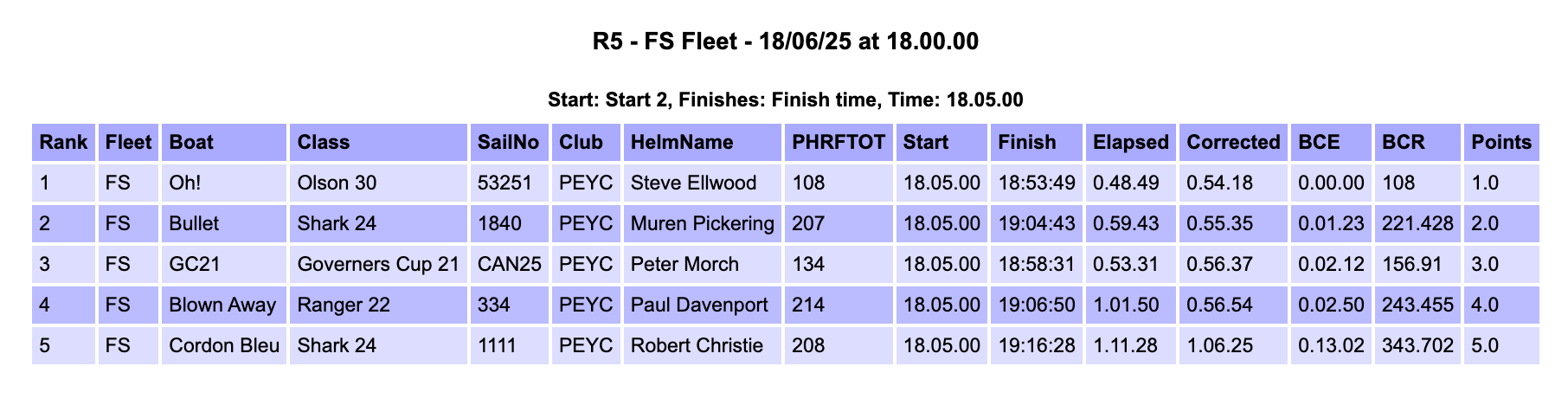
Race Results
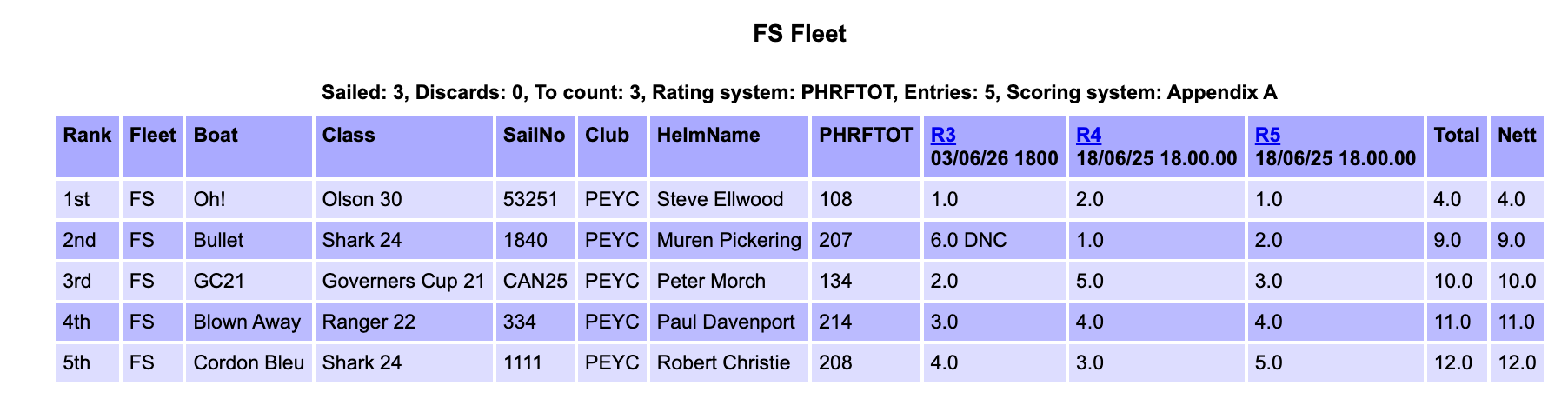
Series Results
Full Table
Race Review
This race ends the Spring series - we think. And we won handily. Congrats team!
Full Main, #1 , Grey/Purple Spinnaker 6 people on board
With the crew bodies we were able to hold the boat down and get the most power possible, without being overwhelmed by the #1. The performance shows in the results. We were always fast. The breeze was both a little shifty (not crazy Picton Bay shift, just a little) and a little puffy - both reasonable, and we could work with them. Tacking on the shifts, sail controls and steering in the puffs.
Comms Comms Comms
Everyone was alive to the wind. There was lots of comms from the crew about the next lull or puff, comments about patches of breeze, whether we needed to tack, gybe or on the run slide left or right. It made a huge difference to decision-making.
Picton Bay Strategy
We have adopted the Picton Bay strategy of not coming to the starbd layline until 10-12 (300’-360’ feet) from the mark. Attempting to predict the wind near the windward mark in Picton Bay from a distance leaves you either wildly overstood and reaching to the mark, or wildly understood and in traffic. So we flip to starbd to approach the windward mark well inside, and then make the last port tack approach leaving us about 10 boats from the mark before we flip over. At that point we can make an pretty good guess where the layline is - and it might stay there for the time it takes us to get to the mark. This strategy also gives enough time for the bow team to set the pole and ready for the hoist.
Helm Stays on Low Side on Mark Approach
We have also learned that on the last tack from port to starbd Lynn needs to stay on the low side to allow her to see the mark and potential approaching boats, to give her what she needs to track towards the mark with confidence.
Adjustments
We also have adopted a routine where we adjust the sails and rig for the downwind leg once we are on the downwind leg - no adjustments on the upwind leg because it hurts our performance. The reverse is true at the bottom, leeward mark - we adjust the sails and rig for going upwind as we approach the leeward mark, so the boat is ready to turn upwind and start making immediate progress. Adjusting controls while going upwind is doable - but slow. A mis-adjusted rig to a tight cunningham on the last few feet of the downwind leg hurts us not at all.
Leeward Mark Approach
Be Inside
We also have grooved in the idea that we want to be on the inside of every mark rounding - if possible. Of course we do, everyone does. But we have learned that if we are on the outside, 2/3’s of the way down the track, we have to consciously make the move to cross the boats head to get to the inside of them. Last night we took the Nonsuch 26 Salem (John Vincent’s boat) up so we could cross ahead of him quickly. The cross was very close, but it was all communicated and in good spirits. We played with Sara, Chris Anisle’s Tanzer 22, as we attempted to roll over her. She took us up - we with a spinnaker (and no pole) and Sara with while sails. Luckily we reached the 3 boat length (longest boat so 90’) circle before Chris could wrap our spinnaker around our forestay. In future the lesson here was pass high enough to weather that the boat being passed would have to head up far more than they want to in order to mess with us. Being on the inside made all the difference to that rounding.
No Spinnaker Pole Required
Our process is to (1) Move the jib from port side to starbd side and set the starbd sheet in the jammer to a close reach setting. (2) get the jib up in the last ⅓ of the downwind leg. Later is better for performance but the amount of time required to get set if the deciding factor. This gives us time to cross sheet the jib halyard winch to get some halyard tension loaded up. (3) By being on the inside, sailing a little hot to get there, the mark is now dead down wind (DDW). (4) Helm squares the boat to DDW and the pole is removed. Having 6 people meant that I could come up to be the “person pole” in place of the actual pole to keep the spinnaker flying. (5) Set the rig and sail adjustments for upwind (6) The bow team stowed the pole on the boom and readied for a drop. (7) Spin sheet trimmer sets the spinnaker sheet in the jammer to allow the starbd winch to be unloaded and the allow loading the jib sheet. Spinnaker trim is done using the guy for the last little bit. (8) We were two boat lengths from the mark, the bow team grabs the guy (windward take down always) from the ‘person pole’ (or if they are the ‘person pole’ they already have it in hand) - then starts pulling in the sail. The Cockpit team must unlock the spin sheet from the cheek block. The person pulling on the guy calls for mast person to release the spin halyard. Mast and bow drag the spin down and shove it in the open hatch. (9) Once the chute is coming down we should be about one boat length from the mark. The cockpit team can forget the spinnaker and focus on getting the main and jib trimmed for the turn. Ideally the trim happens as the turn is made. (10) Turn, and we are inside, heading upwind fully trimmed and pointing on a close-hauled course. Bodies on the rail as quickly as possible.
Helmsperson-ship
Lynn is not used to the big #1. Our racing has been with the #3 and her women’s team using either the #3 or the new #2. So getting the turning rate right for the wind strength and the size of the jib was a challenge.
Using the #3 a tack was like snapping your fingers. No skirting, no wobbly course. Snap.
But the #1 takes time to get around the mast.
The bow team did a good job ensuring that the clew didn’t get caught on the stays or the mast.
I found myself overhauling the new lazy jib sheet.
The process of getting the sail around has two essential parts - (a) Helm’s driving, and (b) Everyone thinking about the jib sheet and ensuring they are free to run. No foot cleats, no tangles in the line locking them into a block, no snags, and especially to our horror - no knots.
Lesson - Main trimmer should run the jib sheets after every tack as part of their job (ok, me last night and I messed that up).
So what should the helm do with regard to steering? It’s the golden rule ⅓ slow, ⅓ fast, ⅓ slow.
That last ⅓ slow is critical because the trimmer needs time to draw in the long jib line and in doing so they can keep the foot of the sail inside the lifelines - no skirt required.
And we are going upwind during the tack.
If we blow the foot outside the lifelines we have (1) come down too far - so losing ground upwind and (2) need to send one or more crew to the low side to skirt - losing power with fewer bodies on the rail.
Race Review by the Numbers
We corrected to 54.18 minutes around the course. We won Flying Sail (FS) by a handy corrected 1.23 minutes over Bullet - who had three people on board. The GC was behind us by 2.12 corrected - they are learning a masthead symmetrical spinnaker on that boat. I expect they will improve a lot in the next series. But if we don’t compare apples to apples and look at the faster Non-Flying Sail boats, and compare ourselves to their performance (as ugly as that comparison is) we were behind Lickety, (54.01), and just ahead of Bear (54.30). The slower NFS boats, Shannon Coull in True North, Hunter 27x, was well ahead of us with 52.27 - and won the whole damn thing by a lot - the joys of a 198 NFS rating. So mixing the fleets together we came out 3rd. Sigh, the pain of PHRF racing.
All of this to say we are sailing well but perhaps not up to our rating - yet. The team work is improving at every outing, and it’s a pleasure (a JOY!) to sail with this group in its various configurations.
In preparation for the weekend events Lynn and I will be scrubbing Oh!‘s hull on Friday. Every little bit helps!
Comments
Name and email required; comments appear once Steve approves them.