Creation: 260625 0506 Last Modified: 260625 0506
This is a footnote to this posting at the bottom, with Howard’s recollections and Steve’s follow up See bottom
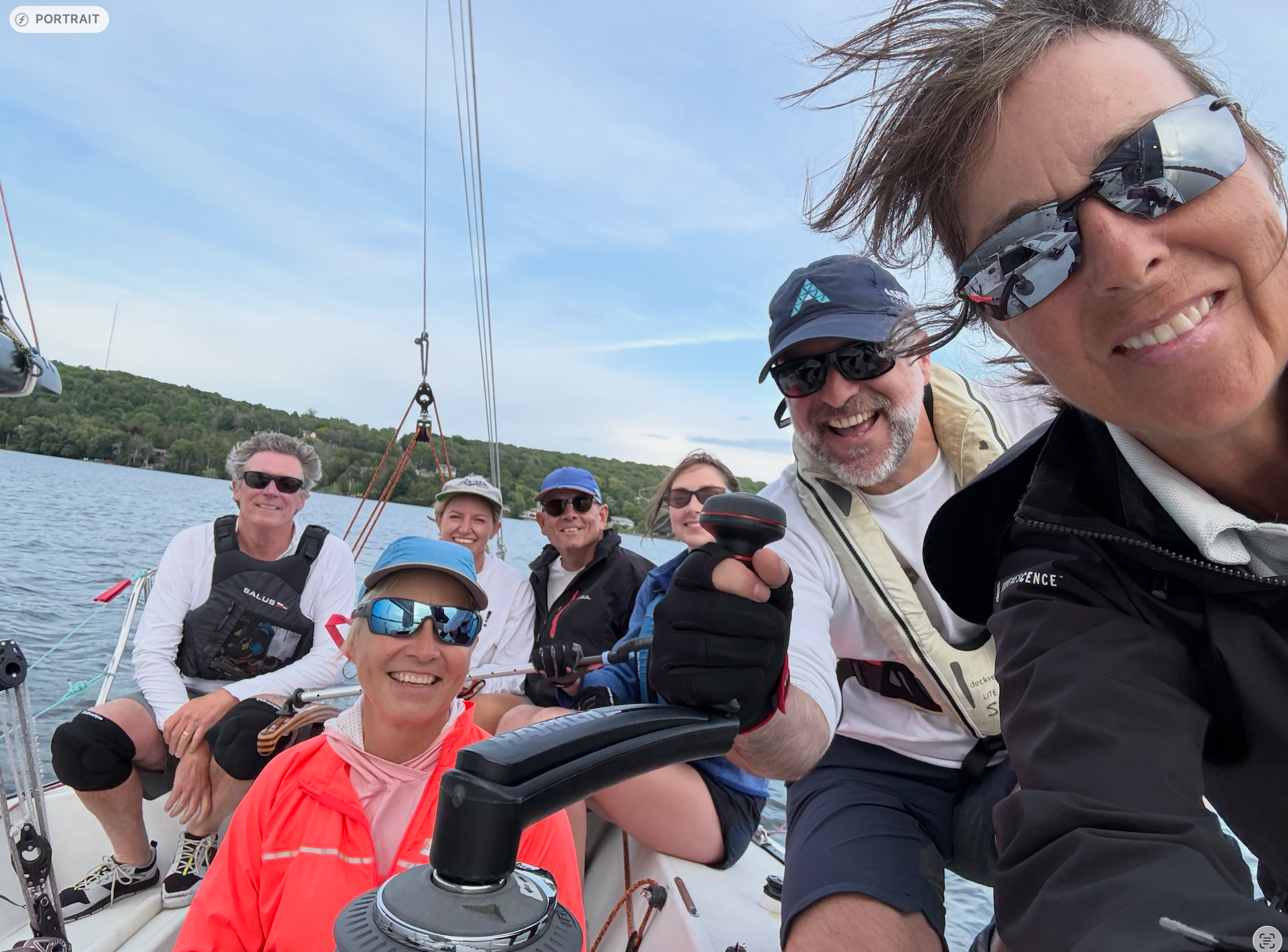
Crew
| Position | Person |
|---|---|
| Helm | Lynn Ellwood |
| Main | Sue Fraser |
| Middle 1 | Steve Ellwood |
| Middle 2 | Melissa Ella Warren |
| Mast | Joel Massicotte |
| Bow | Howard Whittaker |
| and special guest Jules, one of the sailing instructors at the PEYC Sailing School - we hope to see her on board often - It was a pleasure to have her on board. |
Course
J2 Windward / Leeward ~ 1nm long twice around The leeward mark was in the middle of the big bay.
Weather
Leaving the harbour the wind was 10ish knots and pretty consistent. We rigged the #1. Hey we got 7 crew, we can hold the boat down - right? Well… By the time we got to the start line, the breeze had filled, long gusts of up to 18 knots prevailed. We changed down to the #3 - it was definitely the correct sail. Still it was stead-ish out of about 280 degrees. With shifts as much as 20 degrees, but amazingly they were not frequent.
Race Result
We were 4th.
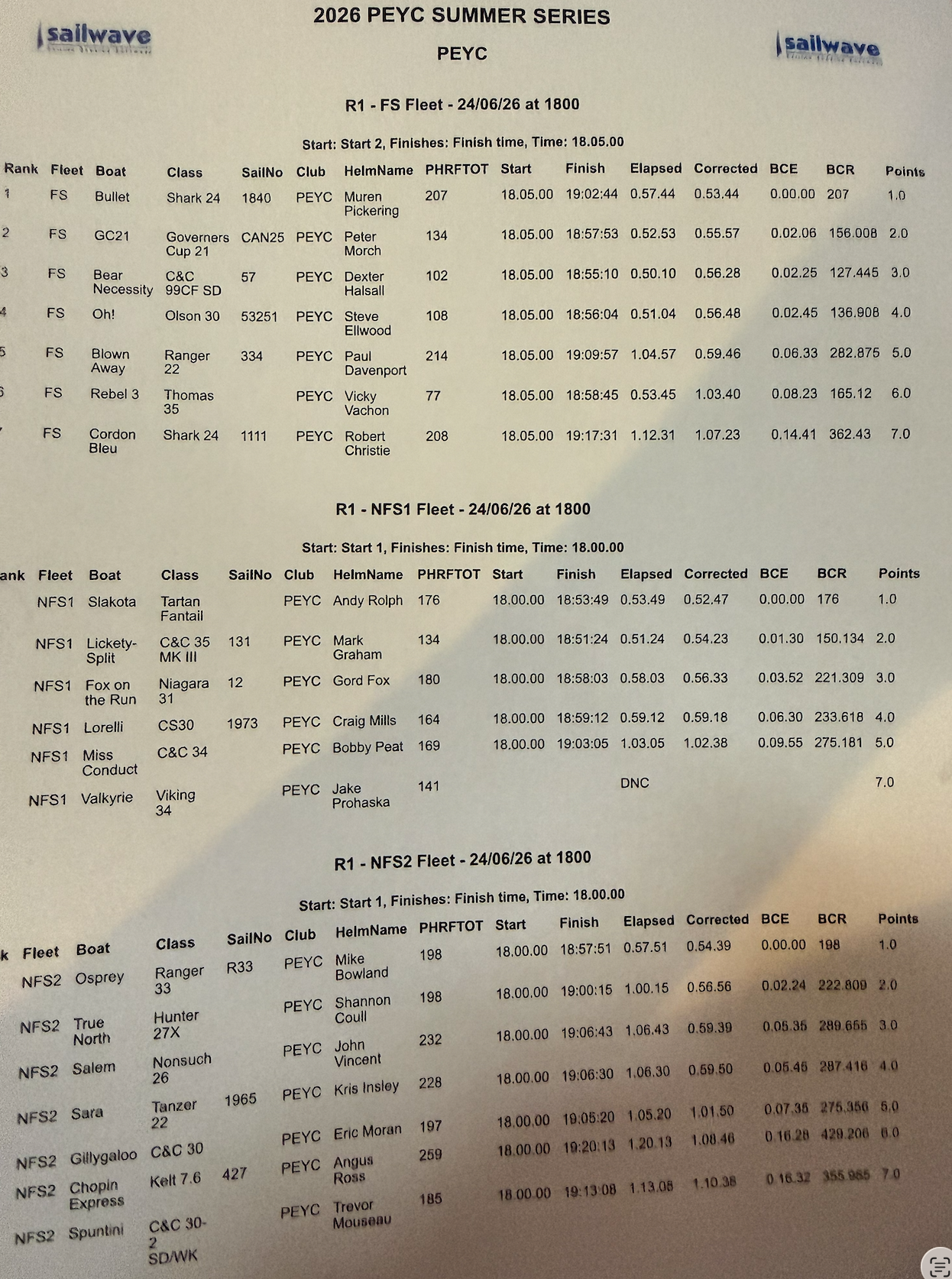
Something difficult - more difficult than what happened to us - happened to Rebel. I don’t know what it was. Their results - behind the non-200 level entrants (they are dead to me - see below) - of more than 6 minutes, is not representative of their normal performance. If I do find out I’ll let you know.
Race Review
We had some new players in the spinnaker fleet, Bear joined us and Rebel. We long to race against boats that have a sub 200 rating in PHRF. From the results one can see that the GC, Bear and Oh! had - what for PHRF qualifies - as tight racing. The 2 corrected minutes Bullet enjoyed over us is a function of (a) he was sailing on another planet wind-wise (b) the Shark rating accommodates for all those terribly sailed Sharks that race PHRF such that their rating is much higher than it should be. The serious Shark sailors sail one-design - and they don’t bother with PHRF at all. So you take someone that knows how to sail a Shark - and Muren on Bullet is not the worst there ever was - and put those sailors in the PHRF fleet - then you get the rating designed for the “not so great” Shark sailors that regularly race with PHRF’s rating applied to someone that knows how to race a Shark. Trouble is, if you adjust it, the whole Shark fleet of knowledgeable and some excellent, Shark sailors, the rating might be 160-180, and that would make the PHRF-only Shark sailors hopelessly uncompetitive and they wouldn’t show up any more. We see this in the Alberg 22, the Viking 22, and many other classes that are sailed by ‘learning’ or ‘not keen’ sailors almost all the time in PHRF, and then a keen sailor jumps on aboard and uses the rating to win. Can anyone say Katie Grey? All 5 Sharks beat every other boat - show up in a Shark and you place. Did they out-sail us, Rebel, Red Jacket, and other keen folk? According to PHRF they did. To be fair, I used this advantage when we were new in the fleet and I raced on John Vincent’s Nonsuch 26 Salem. Those high performance Nonsuchs ya’ know.. Its frustrating, but the handicap system keeps our fleets alive. So we live with it. But that doesn’t mean there is much to learn from Muren getting a first last night - he did show up and he didn’t shrimp his kite - victory was inevitable. So I’m not going to compare our performance with these above 200 level boats - they are dead to me ;-)
The Start
We had a lengthy and helpful discussion - what must Jules think of us? - about the start. In plain ‘what happened’ terms - we tacked around high of the RC and allowed Bear to sail under us, say 6-8 boat lengths from the RC boat. Bear immediately started shouting “up, up”, saying there would be no room for us at the mark. Scary talk. We panicked and took the outside of the RC, wrapped out jib’s battens around the forestay when we gybed around to make a circle to restart but we wrapped the sail around the forestay which stopped us cold. We had to RE GYBE to unwrap the sail on the forestay. At that point we had no trouble crossing the line because everyone, everyone, had crossed already. The wrapped jib was my fault. I was running the jib trim and calling tactics. During the gybe I should have brought in the jib sheet in to keep the jib from wrapping - but I was distracted and didn’t do that. This is a lesson I have learned - many times - perhaps ‘learned is the wrong word here’.. See below for lessons on this. Off we went, with our deficit to make up. We applied the Picton Bay Strategy and tacked low of the layline because we can’t predict the shifts once we get close - making finding the actual layline from the corner of the course impossible. Gord Fox in Fox on The Run - arguably the most experienced and winnest sailor out there over a 50 year run - was seen reaching into the windward mark having blown the layline call from the far right side (west) of the course. At the windward mark we surprisingly were back in. the game. Bear went hard left at the start from the middle of the start line, we were at the RC and tacked out earlier to port. Now we are faster than Bear according to our friends a PHRF, ""CORRECTION - Bear is 102 compared to our 108 - they owe us"" - but having done two gybes and spending time messing with our wrapped jib before even crossing the line after the gun - it was wonderful that we were at least in touch. The mast/bow team were exemplary. My earlier attempts to channel my inner Howard and work the bow as he does have been shown to fall far short of the mark. Joel and Howard worked together like a well oiled machine. Good speed, up to 8.4 knots at one point, we worked out way past much more of the fleet. But we couldn’t catch Bear. We were watching and a little bit covering the GC21 (old habits die hard). And we did stay in front of them from that first windward mark for the rest of the race. The gybe with the spinnaker was good and we ran our game plan to come up to the mark on the inside (no one was around for us to contest with) and we soaked down, no pole, and pulled the spinnaker down within about 3 boat lengths of the mark. The long windward - we may have done too many tacks. The crew called pressure and Lynn and Sue worked the boat to keep it on its feet and moving fast. Another solid rounding and we were off again. We had worked through most of the fleet by then. Lorilei sailing white sail this series was the last one we caught. We were never able to catch Lickety. During the run I called a gybe upper mid-way down the course to partly cover the GC that had just gybed behind us. Sue noted that the breeze on the left side (East) was strong and solid, and she believed (correctly) that not gybing was the right thing. After considering, I called off the gybe, but the mast/bow team didn’t hear me - so we gybed the pole and then put it back. Because we stayed in the pressure on the east side we did make some gains. Weirdly (Picton) we were tight reaching on the port gybe when we approached the leeward mark for the last time. Lynn went as high of the mark as we could carry the chute before turning down to allow a windward take down - but “down” was about reaching not DDW (dead down wind) so it was a challenge for the bow team. We did a wide and close rounding - nice. Coming into the mark we were on port tack with the goal of crossing the line at the RC. Good pressure. But the wind shifted (of course it did - Picton) and we kept sliding down, sometimes low the boat. I called that we would tack right at the boat. The reason for this was to make irrelevant the speed we lost as we tacked. If we tacked at the boat and crossed the line, being slow for a boat length didn’t matter. Lynn didn’t understand what I was calling for and lost her nerve. She called for a tack and we limped across the line on starboard after getting back up to speed well above the RC. Didn’t matter very much, a second or two.
So the GC21 corrected to 52:57, Bear was 19 corrected seconds behind. I noticed that Bear ran its poled out jib for one or at least part of one of the downwind legs - I don’t know why. I expect if they had gone ‘fully monty’ and hoisted their chute they would have had those 19 seconds back. We were 20 corrected seconds aft of Bear. A TRIUMPH of recovery given our parking up, having lunch, a little nap , then starting… Obviously if we had nailed our start we would have recovered those seconds I expect. Well sailed team, and despite the challenges, given our learning, it was a pleasure. Thank you all. I welcome your comments in the Text Channel.
Lessons
Gybing the Jib
You can’t allow the jib sheet to be free while gybing. If you do, the battens will catch the wind in front of the forestay causing them to wrap and get stuck in the wrap. Pull the jib sheet IN before the gybe then ease. Sounds easy - I wonder why I can’t do it?
The Start
Think of a Bear, coming in to the line. They have speed. They are pushing right at the RC. They are vocal. “Up and Up, no Room there, go away” blah blah blah.
They are heavy and they have speed. We are light and nimble.
Sure there was no room 10 seconds before the start. Zero, we are dead - sad. ;-(
But where is Bear going to go in those next 10 seconds? They are almost at the line.
They have to go down the line - and hope they have room to do so.
That “no room” they were shouting about couldn’t be preserved - if they came up they would prematurely cross over the line - and they don’t want to do that.
So our play - in the moment as things evolved - was to slow down. Bye, bye Bear.
They slide past us and begin their merry journey down the line and guess what? There is lots of room at the boat now - for us.
The key for us was to slow down.
How do we do that?
(1) The sail trimmer - the people with their foot on the gas pedal - have to ease, even rag, the sails. Maybe bow needs to grab the jib and backwind it. Maybe the main gets pushed out by the deck crew. We STOP or at least sufficiently slow.
I didn’t call for the jib to be backwinded or to have the main pushed out - that’s on me.
But Sue did ease the main and I eased the jib.
(2) The helm can use the rudder like a brake. Fishtailing - hard up get a little space, then hard down, rinse and repeat - fast.
Bear can call all he wants and threaten dire consequences. But we are going up, slowly in a seaman like fashion and they can’t seal the deal on us because they are early. Bye, bye Bear. But as I said - we panicked. Helm didn’t fishtail (again that’s on me - I should have given those instructions) and instead with lots of voices in her ear she tacked to respond to Bear’s nonsense. The loose jib tacked and didn’t get pulled in before the subsequent gybe. Disaster. I’m not complaining - I very much doubt Lynn had ever seen a situation like that as a driver. We have seen it many, many times when I’m the driver, but it’s not the same when you have the stick in your hand. And I know that, when it comes up again - and it will, the instinct will be to make the same mistake again - because it takes a little nerve (ok, a lot of nerve) to pull it off. But in time it will come. Again on me for putting Lynn in this tough situation.
So take aways
Tactics to direct Helm
The Crew is talking to Tactics not to the Driver. The Helm is deaf to the input of the crew - even though its critical and needs to keep coming and coming and coming. Never stop (until politely asked to do so by an overwhelmed tactician ;-).
The tactician will filter the information, hopefully process it and give the driver and the trimmers direction.
And when bad things happen it’s the tactician to blame for the directions given. Period.
We didn’t do that last night.
This is a little different from the crew calling the wind. “Pressure in 3 boats” - that information goes directly into the ears of the helm and trimmers. They are expected to act on this information by preparing for the coming change. Not the same set up at all as a tactical situation.
Although tactics can engage with the call that a big puff is coming by calling for a tack, instructing helm to stay low in the puff and not use it to climb, and for the trimmers to give a little ease - why? Perhaps its tactical and we want to use the speed to roll over someone or make a cross.
But if the tactician is silent, the helm and trimmer are expected to take action based on the information flowing from the crew about conditions.
So the natural inclination is for the helm to hear the crew’s feedback and comments during a start of any tactical situation and … take action. Natural.
But we can’t do it that way.
We are each blind, examining an elephant from our own vantage point.
https://en.wikipedia.org/wiki/Blind_men_and_an_elephant#:~:text=The%20parable%20of%20the%20blind,the%20side%20or%20the%20tusk.
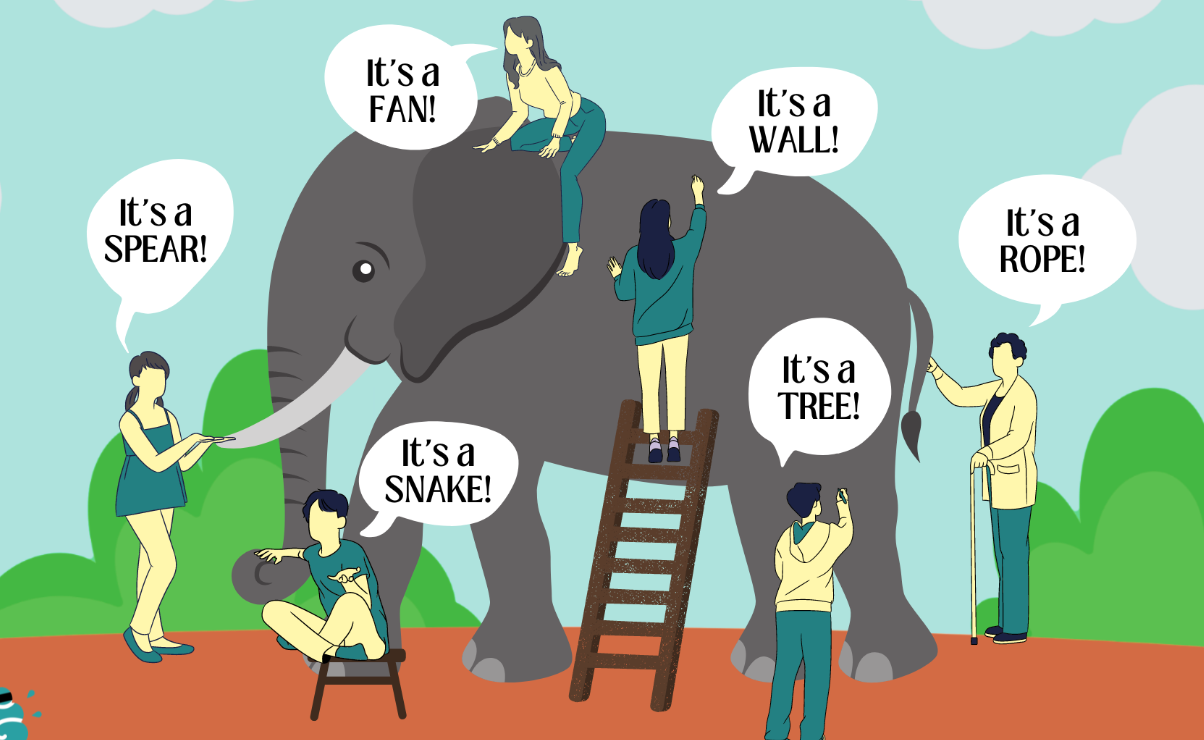
The whole picture is, properly or improperly, put together by the tactician who decides it’s an elephant (hurray) or a lamp post (yikes). Keep the information coming - all the time - the more, the better - but don’t be offended when your voice appears unheard. Ok, it might not have been heard. And relaying messages back is a good thing. But the helm isn’t the filter, the tactician is.
Picton Bay Strategy Revisited
Yes we are right to get close before setting up on the layline. But, too many tacks, even with the adorable 100% jib, is slow. So there is a better balance to be had. Tactics has heard the message.
Low Speed Tacks
Never, if possible, tack before the boat is back up to full speed. If you slow say 2 knots on a tack, that 2 will accumulate in the wrong way on the next tack. 6 to 4, then tack quickly again 4 to 2… Get back up to speed, then consider the next tack. Sure there are tactical situations where those slow speed tacks can’t be avoided - but work to make those situations few and far between.
Finish Line Tactics
We want to cross the finish line as quickly as we can - duh. That means we want to aim at the end of the line that is furthest downwind when we are approaching on a beat. Crossing in the middle is a wasted opportunity IF the line isn’t square - and no line is ever square. Also, if we have to tack to cross at the point we feel is the favoured end, we want to minimize the distance we have to travel after the tack. Of course there are tactical situations that involve other boats that make these “nice to have” choices irrelevant. Last night wasn’t one of those times.
Footnote
From Howard
“Here’s how I remember the race start:
With about 1 minute to go before the start, we were on a starboard tack on a beam reach, sailing fast towards the committee boat. We were going to be early, so we tacked to port (sailing away from the committee boat), then gybed quickly to set up for our start (this is where the jib batten got stuck). I remember looking up after we executed the gybe and seeing the problem. After the gybe, we were on starboard (moving slowly) with our bow headed for the committee boat - that’s when Bear started driving us up. I recall seeing Bear’s starboard back quarter about 4 feet from our port bow side. I thought Bear was right on time, and he’s going to shut the door on us. I thought your plan was to dip his transom. To do that, we needed space to dip…hence the request to head up.
In hindsight, our first problem was the wrapped jib (I don’t think we could have cleared it heading starboard towards the line - we needed to gybe), and our second problem was that we were not strategically in sync at the start. Unfortunate, but it was still fun to see if we could catch up”
Steve’s Follow up There is the elephant issue! Of course, I am sure Howard is right. I wasn’t aware of the early onset jib problem. And of course it makes sense. And of course, it was still my fault as jib trimmer for the not keeping the jib sheets tight during the gybe. And, yes clearing the jib batten problem had only two solutions (1) Gybe again or (2) Drop the halyard if it would come down and manually unwinding it - yuk and double yuk. So the moment I called for a gybe and the batten wrapped we were doomed. Timing-wise I think Howard and I differed about Bear’s ability to hit the line on its course to the RC - I still think (granted through a fog of doubt now) that Bear had to bear-away before the gun to stay on the correct side of the line - we saw them bear away - didn’t we? It’s a lamp post … S
More from Howard
Yes, you are correct, Bear was early and he did bear-away. And, in hindsight, we did not have to “head up”. But at the time, I thought he was on time and he was shutting the door on us. My mistake.
Steve
Nah, just an elephant :-)
From Lynn - 260625 1425 “I thought you were saying “Go down!” when you apparently were saying “Slow down!”, hence no wiggling of the rudder by me. In hind sight, “Slow down!” made sense, and I know how to do that with help from the trimmers, so in a similarly situation I think we can manage it well.”
Comments
Name and email required; comments appear once Steve approves them.