Creation: 260711 0807 Last Modified: 260711 0807
Cautions
A 3-day regatta generates a lot of information and a lot of memories. When there is one race I can often (not always) remember the whole race, tack for tack and mark rounding by mark rounding, but sadly for me three races back to back blur the details. So if I get things out of order please grant me an old guy indulgence. Mostly I won’t try, I’ll give moments recalled as I write this and try to capture the lessons.
Crew
| Position | Person |
|---|---|
| Helm | Lynn Ellwood |
| Main | Sue Fraser |
| Middle 1 | Steve Ellwood |
| Middle 2 | Bob Colborne |
| Mast | Melissa Ella Warren |
| Bow | Howard Whittaker |
Very graciously Bob allowed himself to be put on stand by for a 0700am call to action on Saturday morning. If the weather looked to be super light we would heartlessly rescind Bob’s invitation. Happily the weather forecast indicated we should go with six, so after the challenging drifter of a Friday with no racing, Bob got to join us to actually sail. Thank you, Bob, for your flexibility and your awesome skills.
Course
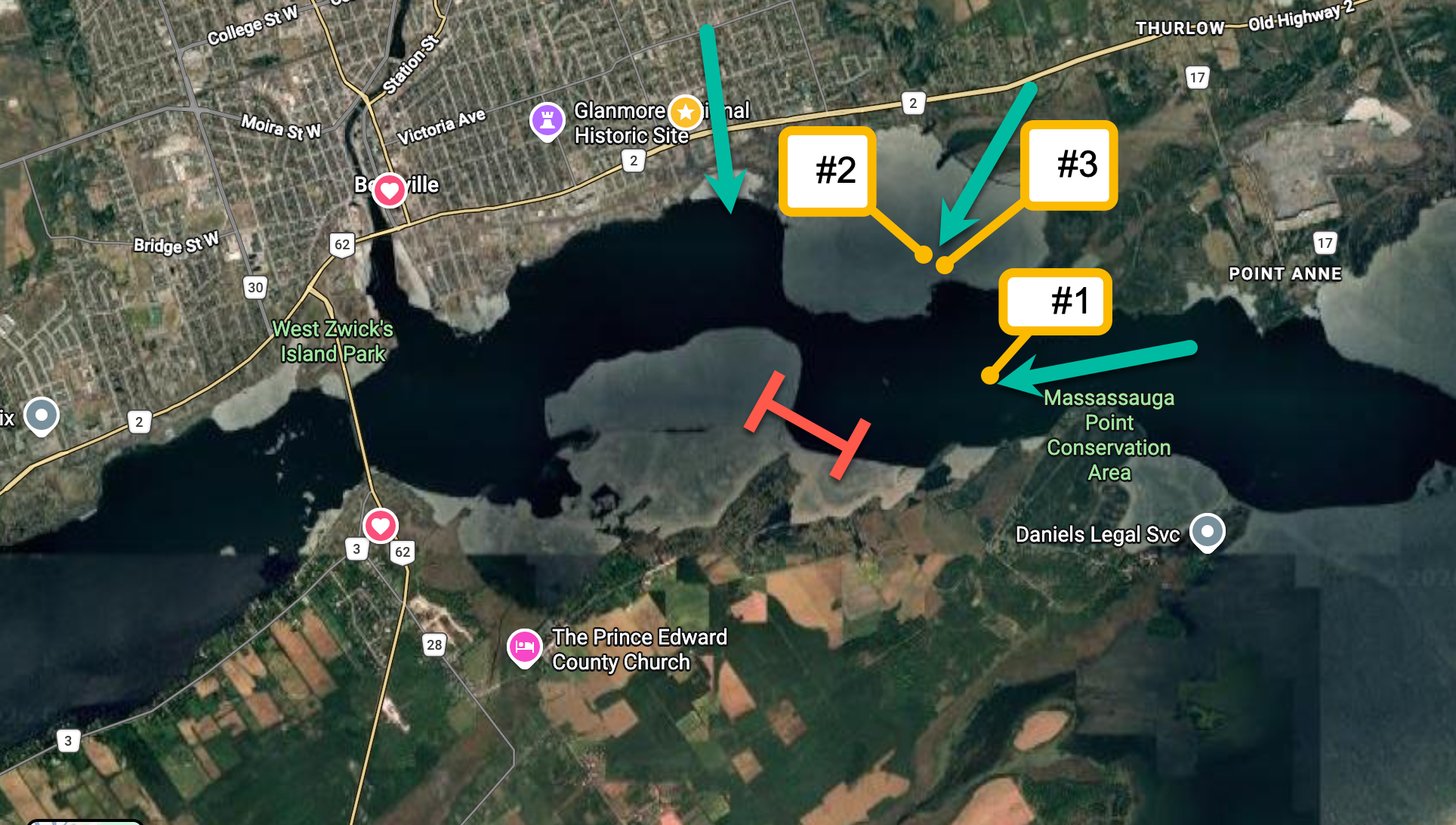
Again with an aging memory I am trying to recall the windward mark locations from Saturday. I think I got them right, for our Division 1 group anyway.
The green arrows are the wind direction(s) over the time we were racing - and or the committee was TRYING to set a fair course. And it wasn’t all moving left or all moving right - it was oscillating arrow to arrow to arrow…back and forth.
The red line is approximately where the race committee set up for starts.
All our course looked like this:
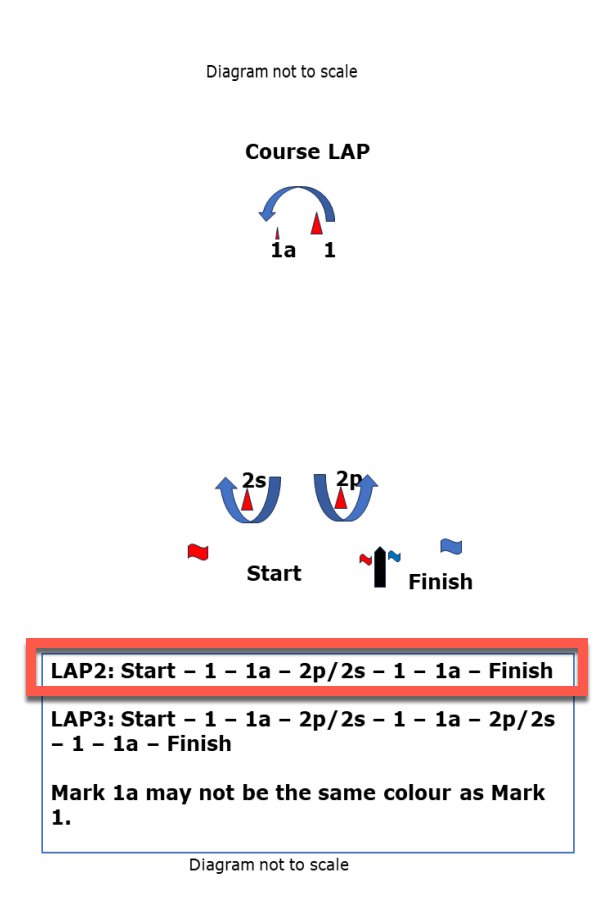
It was LAP2 for all three races.
Weather
Sunny and hot with occasional clouds for relief. A spectacular day to be on the water. As noted above the RC had a hard time setting a fair racecourse. But they did their best under the circumstance - outstandingly well in my opinion. Could they have got more races off? Sure but would they be fair when 40 degree shifts were messing up the starting sequence? We saw 5 knots, we saw 15 knot gusts (top of the #1 gennie). Maniacal attention to the wind direction, shifts, puffs and wind lanes of wind made all the difference. Exchanges with other boats might see us crossing them by 10 boat lengths, only at the next cross seeing them cross us by 15 boat lengths. And happily vice versa.
Race Result
Ok, did we win? Well, yes and no. It’s PHRF with 8 separate Divisions. And overall results for score count and lowest corrected time and and and - the award ceremony was as long as our combined racing time Saturday. I have already noted here https://publish.obsidian.md/oh/04+Boats/Olson+30/2026+Race+Results/260709+EYC+Long+Distance+Race that we got a second in our division 1 (second and also second last - of three boats). In the Saturday course racing we got 3 races in. Our score line was sweet.
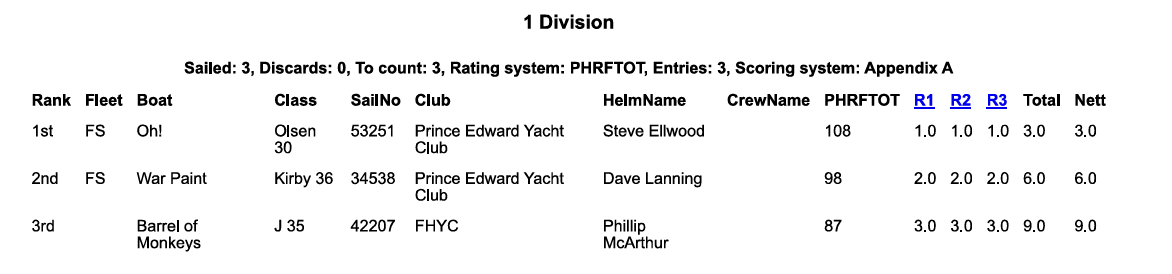
The full score report is below
Pulling together the three races in our Division 1 and examining the delta of corrected time in each race - we did well. Also note the sum of these deltas, we were clearly dominant.
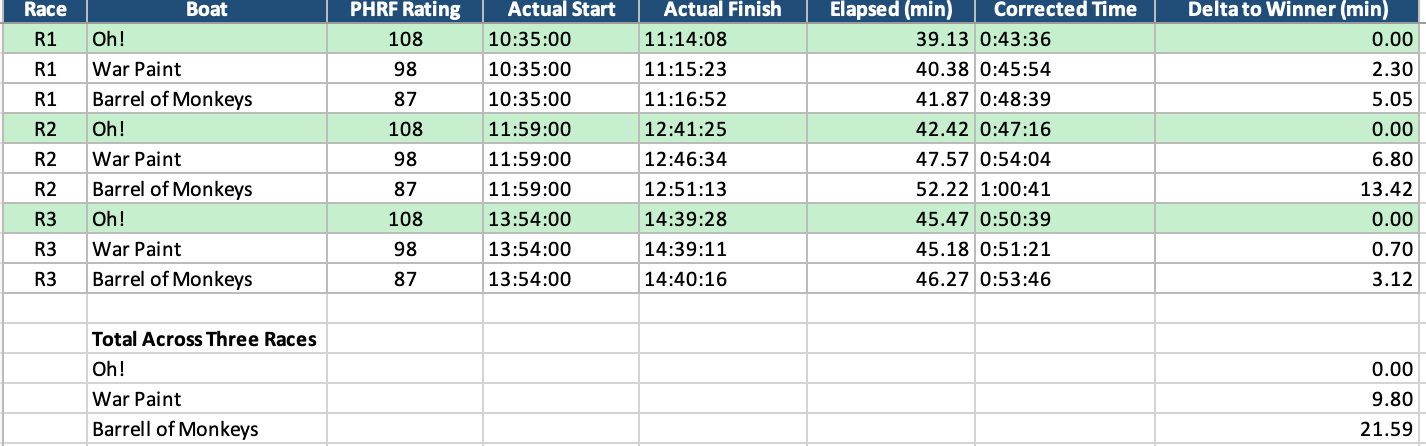
With three bullets we won the lowest sum of corrected times in our division, the Farrell Trophy. And we also won the lowest score line 1/1/1=3 for the best results in the regatta. Looking at it another way, Blaze’s got a trophy that seems to be the ‘king of the regatta’ some how - I didn’t note the name of the trophy. We had Long Distance 2nd and 3 points course racing for 5 points and Blaze had 1st, and 2, 2, 1 = 6 - so I don’t know how the calculations worked. Perhaps it was overall including the Long Distance race and Course Race corrected? Maybe. Anyway, good for them, they sailed brilliantly well. When looking over the spinnaker fleet (3 races) we can compare our corrected results with the whole spin fleet in course racing - we came out like this:
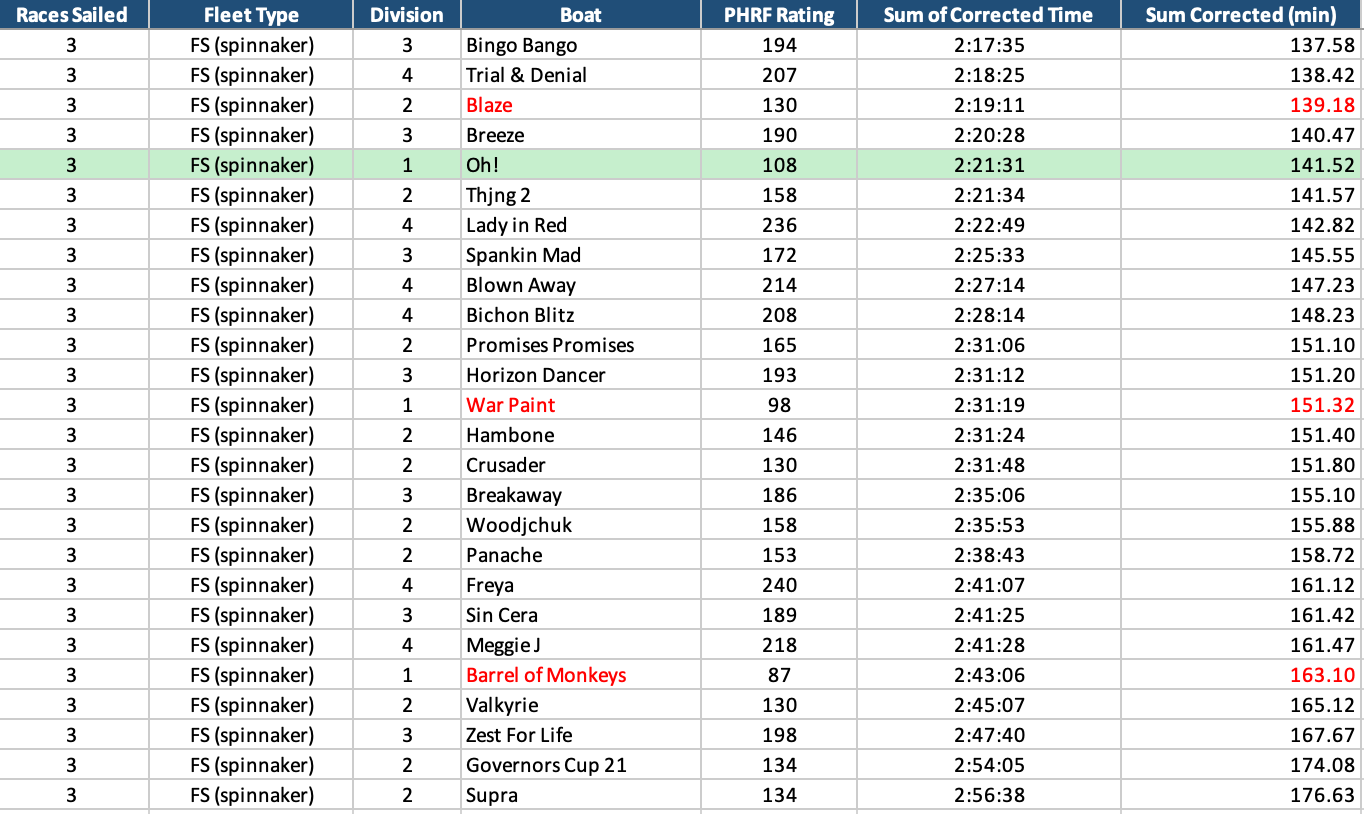
5th on overall spin boats corrected, with Blaze slightly ahead. This is corrected time, so BIG PHRF ratings pay. Bingo Bango (194 PHRF) was a well sailed Impulse 21, Trial and Denial was Shark (207) and Breeze was a C&C 27 (190). What-ya-gonna-do? - PHRF.
Race Review / Lessons Learned
Our crew work made all the difference. Everyone was focused all the time. The wind, the boats we were competing with on the course, the boats ahead telling us what’s coming next, the Race Committee chatter and what that can tell us, the clouds, the forecast, the next manoeuvre, everything all the time.
Helm Stays Still - We found that Lynn needed to remain in a single constant position while helming - unless we were on final approach to a mark, in which case she needed to be on the low side to ensure she was going to make the mark. This rule requires that the crew, all of us, stay vigilant and monitor the heel of the boat. We want say 10-15 degree not more upwind. So too flat, the crew had to naturally move inboard. So heeled, the crew had to move outboard. Over heeled might mean the crew would get their torsos between the upper and lower lifelines with legs extended. When this happened automatically it was magic. Main trim can move from the center of the cockpit, to the seat to the rail and back and forth but they can’t really legs out and remain responsive to trimming demands. I was jib trim and I too had to move in and out but again, jib trim required seeing the sail to be most effective. That left the majority of the in and out - ing to the bow, mast and middle#2. It was a constant dance.
Jib Trim - in changing conditions every puff and every lull required jib trim changes. When a puff hit two things happened, (1) the jib stretched a little - so it needed to be brought in a bit and (2) the apparent wind moved aft a bit (vector diagram boat speed / true wind velocity results in an apparent wind angle). That wind velocity increase speeds the boat up and as the boat does go faster the the apparent moved forward again, adjust adjust adjust. Yes it can be sort of done from the rail using the windward winch either as direct cross sheet or using the windward winch to tail from the leeward winch. Yesterday it was trimmer down low and crew weight offsetting my low side bulk. We are going to experiment with having a lighter person on as jib trimmer when its called for.
Main Trim - Course Sue and Lynn worked together all day managing the weather helm on the tiller with main sheet trim.
At one of the starts, when I put us between a rock and a hard place, we found ourselves being out pointed by a Shark - yup I know, WTF?
The Shark was working it to force us to tack rather than sailing over them. I get it, it was life and death for them. This was Bingo Bango. At the time I was ah, agitated, shall we say that we couldn’t lift off him. Thinking back I believe our problem was in the main.
Think about center of effort verses center of lateral resistance. If the jib is the driving force, its centre of effort is in front of the keel (the centre of resistance), so the boat will want to drop its bow down. If instead the main is strapped in and above the centre line of the boat, it becomes a greater vector of effort force and so the center of effort shifts aft behind the keel’s CoR. This state pushing the stern down and the bow up. That’s what the Shark was doing to us. We needed to follow suit.
Lynn could also have taken bites to weather, even though we would be slowing, in order to gain some separation from the Shark.
As it was, we had to tack away - burned off by a Shark…
I think we need to spend some pre-race time working on the balance between the two sails to figure out how this actually impacts the pointing we can get away with.
Gennie Tacking - The #1 gennie is a beast at 155% of the fore-triangle. Tacking it can be a nightmare, and sometimes it was. A minor imperfection in the path of the lazy sheet, or the new active sheet, will turn a smooth elegant, near lossless tack into a cluster that takes 60 second to recover from and costs a few boat lengths.
All but the helm was involved in almost every tack yesterday. Everyone was conscious of the need to ensure a smooth running of the lines.
I, as middle #1, was staged with wraps on the ‘soon to be’ new active sheet on the high side with winch handle in the winch.
Bob, as middle #2, jumped into the companion way (like a 20-year-old acrobat), and broke the old active sheet when called, and unwrapped it quickly from the winch completely. He then reached out in front of the fairlead to ensure the sheet was free and moving.
Main, Sue, would look at the sheet at the cheek block and ensure it was running free.
Mast, Melissa, was on hand to ensure the clew and its bowline attachments got around the shrouds and the mast.
Finally, Howard was on the new low side to ensure the gennie came in and was skirted.
I pulled with everything I had and shouted when the line was not moving.
So that’s all that is needed to ensure a smooth tack with that sail, 5 focused obsessed people - easy, peasy.
Spinnaker Tapes - as I had relearned the lesson for the umteenth time on the LD race, Howard kindly took the time to run the spinnaker tapes every time before a hoist - funny no wraps - strange huh?
Trim Cycle - I think that’s the phrase, I know cycle is right. Sue gave Melissa this as a verbal macro to direct her to execute the various adjustments required, cunningham, outhaul, boom vang, it also applied to Bob and I as middles, for potentially main halyard and jib halyard eased or hardened up, and backstay. That phrase (ok not that I can remember the first word) was a great timing prompt.
Spinnaker Trim - It was shifty. Bob and I worked together he on the spin sheet and I on the guy. When I saw the luff curve break I eased the pole forward a little and he brought in the sheet a little.
I would then start cheating the pole back until the break returned.
This was a constant dance between us.
The danger is that my pole moves could de-power the boat. So will this technique always work? No, but its worth doing until its shown not to work.
Our boat speed was amazing down wind, our ability to sail deeper that another fast was a function of again obsessive focus on trim and Helm, Lynn, noting the current speed and whether she had the boat powered up - then what she was going to do about it - I’m heading up in the lull, I’m heading down in the puff - it was all a symphony.
There are no doubt more lessons - I’ll note them as I recall them. I welcome everyone’s comments, and additions.
Comments
Name and email required; comments appear once Steve approves them.