Creation: 260716 0507 Last Modified: 260716 0507
Crew
| Position | Person |
|---|---|
| Helm | Lynn Ellwood |
| Main | Sue Fraser |
| Middle 1 | Anik Karimjee |
| Middle 2 | |
| Mast | Joel Massicotte |
| Bow | Steve Ellwood |
Course
J2, each leg about 1.5nm each leg.
Weather
Smokey. From Ontario forest fires. Surreal.
Light wind, 4-6 knots from 250 sifting hard to 280-290 after the start.
Race Result
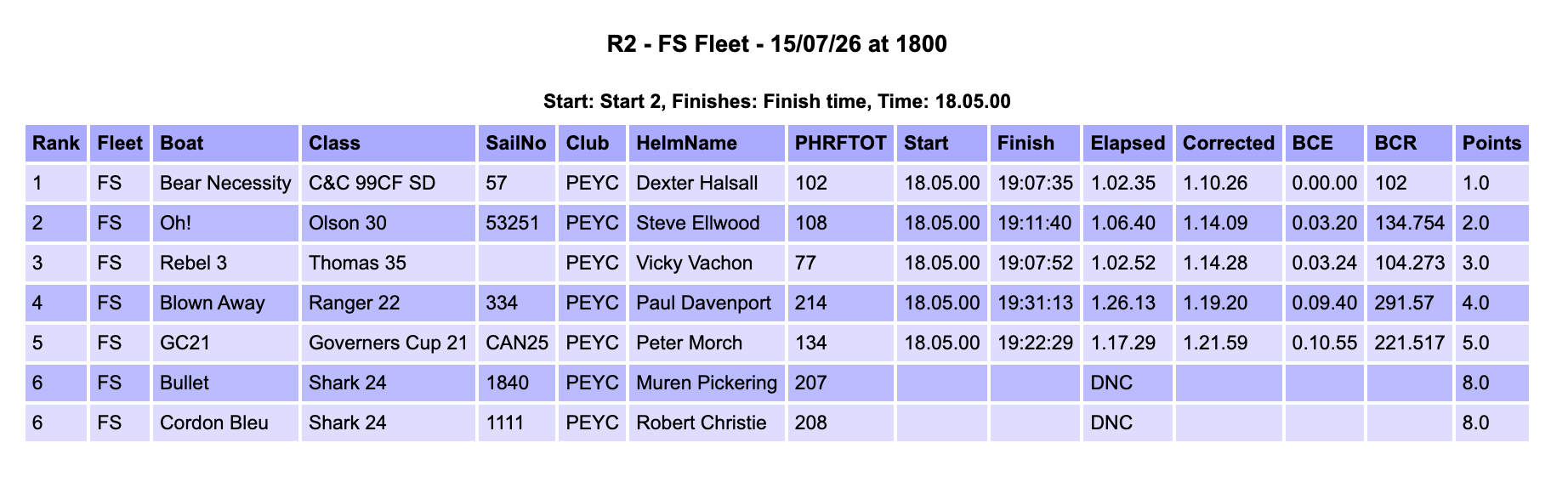
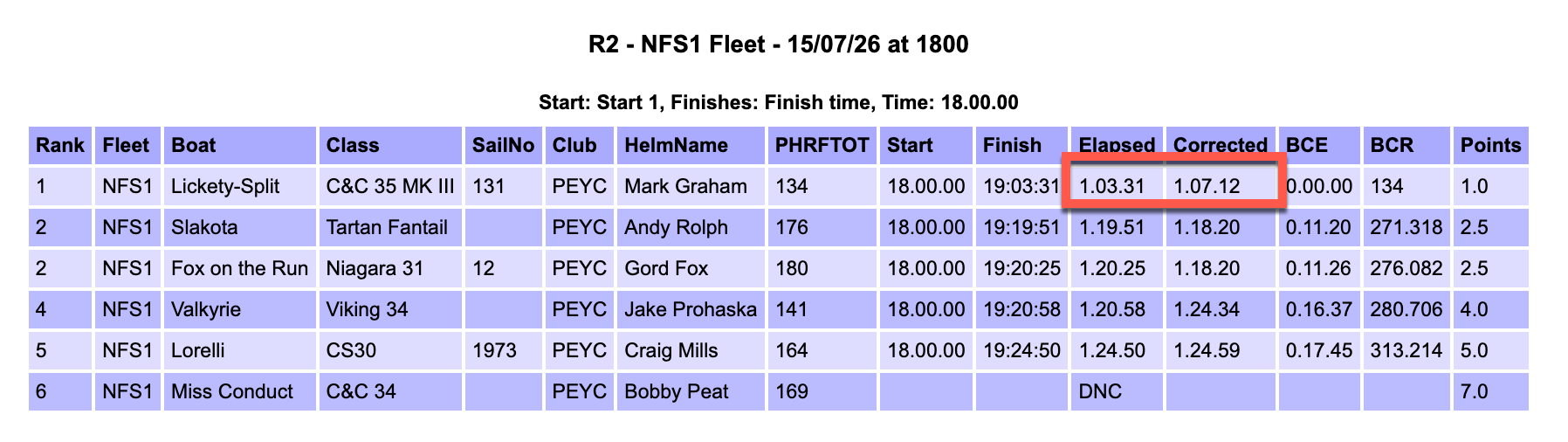
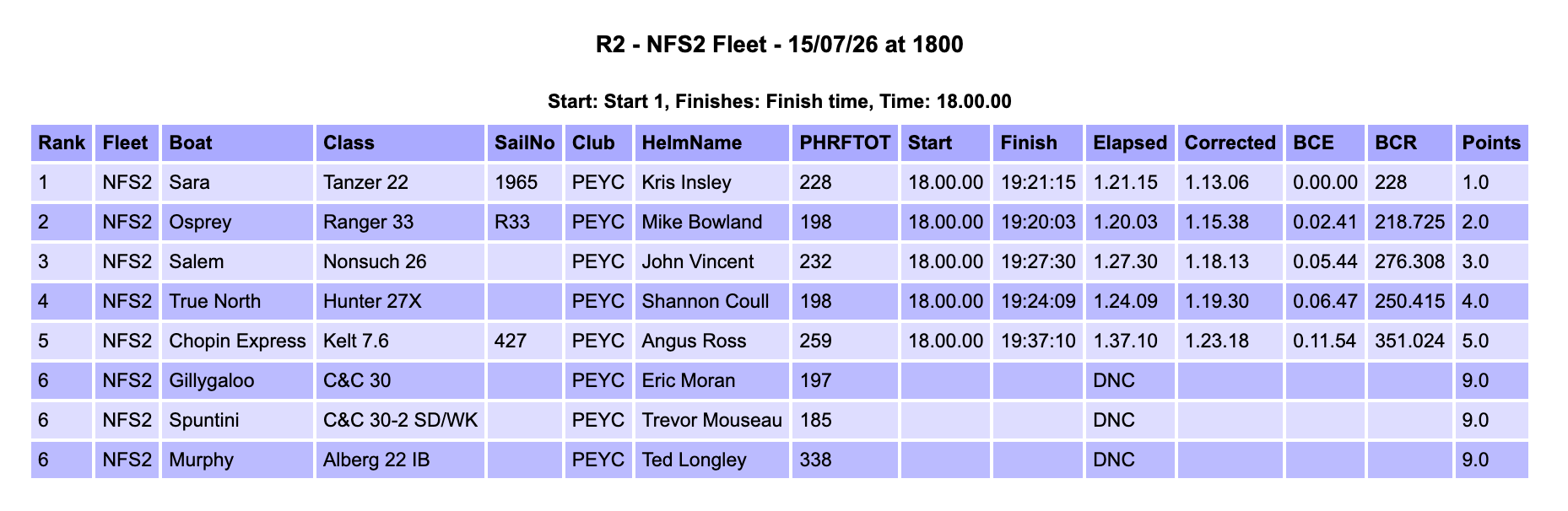
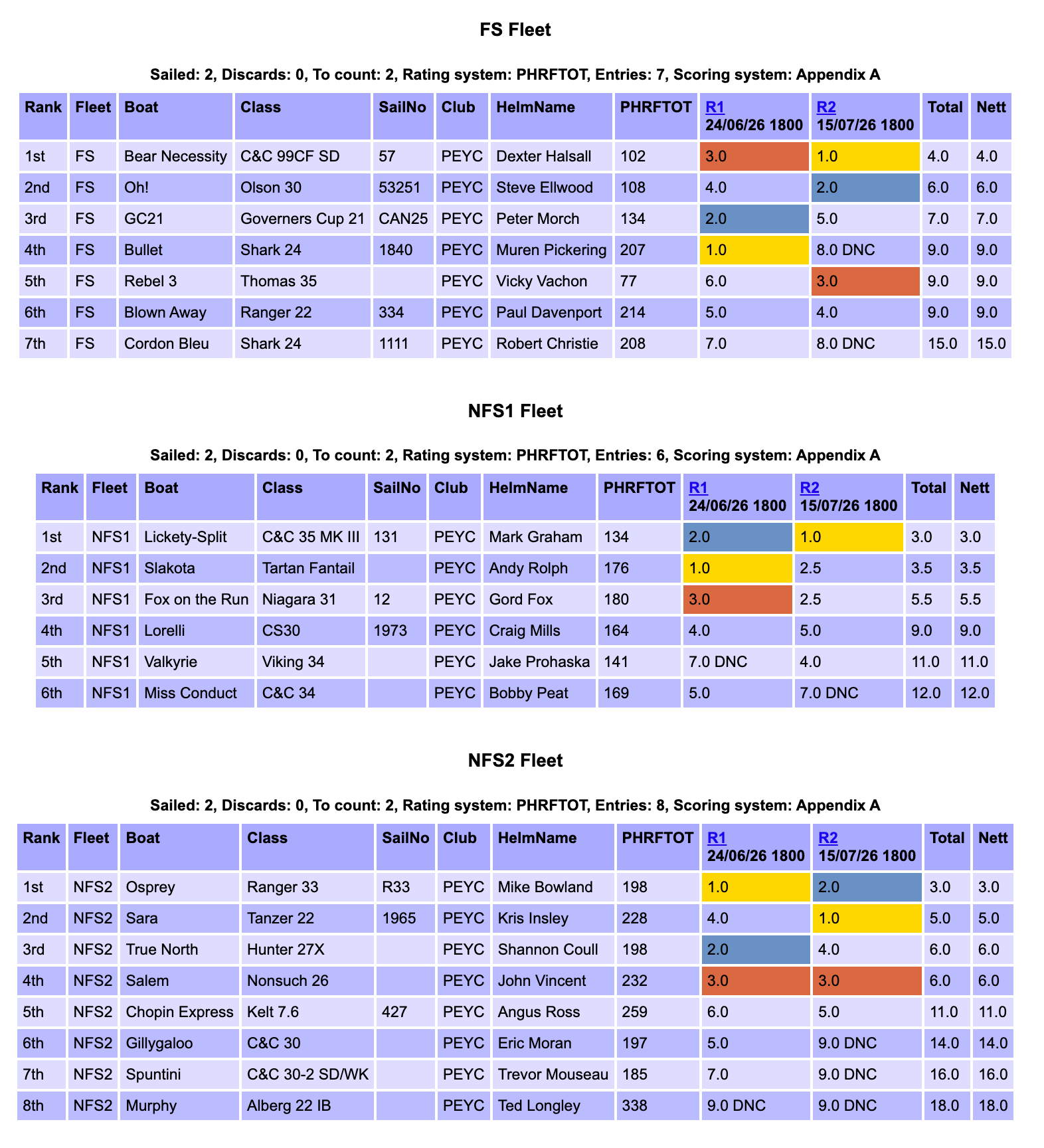
Corrected 1:14:09 4 minutes behind Bear. The real story is Lickety. They were white sail, and the wind gods smiled on them - 1:07:12 corrected. Unbelievable. Well done them. Across the corrected time fleet FS and NFS, we were fourth behind, Lickety, Bear, and Sara.
Race Review
The breeze was soft. Before the start there appeared to be wind on the west side (boat side of the line).
We watched the first start and saw that everyone, everywhere after the start was parked. Boats drifting, sometimes 150-180 degrees to each other’s courses. Ugly.
I asked Sue to run the start, and I suggested boat end of the line with freedom to tack out.
Lynn driving and Sue calling the shots, Sue set Lynn up for a close reach approach to the line beautifully timed.
The usual parade of “bargers” was well above close reaching. We met the whole fleet at the committee boat and patiently explained there would be no room for Bear and Rebel to squeeze between us and the boat at the start.
In the light air, both had to spin head to wind just before the start on the wrong side of the committee boat. And then Bear got stuck and couldn’t come down because the parade of little boats was marching in.
All in all it was a brilliant start - well done Sue and Lynn. Beautifully executed.
We were off on starboard, clear air and no one across the line yet.
There was no reason to tack over to port even though we were clear. The Non-Flying Sails boats in the first start were still scattered around the course like a child had thrown some jacks on a table top. Avoiding them was important.
Of course pressure was more important.
Lickety was on the east side, course left, and they were good until they weren’t - they went too far and the wind was soft.
We had to decide if we were going to tack short of their line to ensure pressure or over stand a little and be above them. By the time we got there the wind was good, so we went above them before we tacked.
Wind good is overstating - there was enough wind to move. 5-6 knots. Gently gently.
We had to cross some of the NFS fleet before we got to the mark. Lorielli, who tacked out on port at the start and looked terrible for most of the leg, came barrelling in on starboard as were approached them on port. We did not want to tack. It would be slow and cause us to painfully overstand - in traffic.
We asked them if we could cross and the answer was confusing. We were making it until the wind shifted - we were headed and they were lifted and we … were dead. Some how we crossed and Lorielli no doubt (although I couldn’t see it myself) altered course a little. I went to repay the kindness by picking up their bar tab after the race - but Craig Mills had already paid - we owe them next week.
So, great start, good wind to the windward mark, we have already passed 3/4 of the NFS fleet. e tacked over too short because of the traffic but on a line we could make. Nope - the wind gods giggled and we were headed 20 degrees. Ha ha. 5 boats from the mark we tacked and took the stern of Angus. John, in his Nonsuch 26, was to leeward and below us a little, but he got an overlap before we entered the circle and we had to give him room. Way to go John!
The serious challenge we had wasn’t the start, the wind, or the other boats. The big problem was on the bow of our boat - ME.
I was bow-human. Joel was mast. Joel did an excellent job, me, not so much.
Why?
I’d like to say lack of practice, and there was definitely a little of that. The order of operations - matters. And in the light wind I was not paying enough attention to the steps in the order they had to happen. Throw it up and it will be fine - ya no.
Well ya, throw it up, and it will be fine - if you have prepared the way and thought it through.
I should have been mediating on channelling my inner Howard. But alas.
We did get the sail up in the air thanks to Joel’s heroic efforts. And off we went, 10 boat lengths from the windward mark…
But the wind had continued to bounce to the west, such that the surface wind was much farther to the west than the upper wind.
The windex said broach reach and the back of the boat said come up come up.
But the spinnaker wouldn’t fill, because the lower wind - the wind in the sail - was close reach.
Confusing.
Lickety didn’t care, they were white sail. They had their lower section of their jib in for close reach and the upper portion twisted off for broad reach - they were GONE. We had not come half way down the course before they rounded the leeward mark.
My vision was to keep the boat moving. The wind was light. Movement pays.
My thinking was that with movement we build apparent wind and so the more wind we would have to work with. Albeit in the wrong-ish direction.
Eventually (well certainly well before I decided to abandon the spinnaker and go with the #1) the wind made carrying the chute impossible.
We did a tight reaching windward take down.
It was during this move we set ourselves up for a catastrophic hoist the next time around. The spinnaker pole got loaded on to the mast twisted, the topping lift and the pole down were wrapped. The pole up topping lift was then tucked behind the pole end at the mast - read to add to our suffering later.
With the gennie up we recovered some lost ground but not enough. The breeze filled in from the west side of the course and we were on the east side.
John was pointed the Nonsuch at the leeward mark immediately after rounding the windward mark, and he was much faster than we were the whole run because he had breeze-ish and we didn’t, except at the very end where we finally caught him and rounded the leeward mark in front of him. Again. well done John and Sue!
Upwind and trying to stay high. We were one tacking it to the windward mark now on stbd. We caught Rebel and we were reeling in Bear - we were fast. Lynn’s steering was good. She sat in one place and the crew moved weight to adjust the heel of the boat - instinctively. Joel and I moved in and out, back and forth - gently, since abrupt movements would also disrupt the speed. I could hear Lynn and Sue exchanging information about weather helm and trim. It was awesome.
We were back in the race. Mostly.
Obviously we had to get to the windward mark on stbd, spin around to port and head back down wind. Obviously a gybe-set.
The wind was light - hold the guy in your hand directly from the chute light. So what could go wrong? Uh huh.
A gybe set is a no pole operation - because the jib is on the side you want the pole to be set at eventually. So, there are a few ways to do this. Way 1 - re-tie the spinnaker so that it is hoisted INSIDE the gennie while on stbd immediately after rounding. Then gybe the gennie and drop the gennie. Then get the spinnaker flying without a pole and get the pole set. Fair enough. Call it a reverse Mexican or reverse Kiwi.
Way-2 - turn the boat around the mark, gybe the gennie, grab the spinnaker and drag it around the front of the boat before hoisting it. Get the halyard on the backside of the gennie, get the sheet behind the gennie. Hoist, be the pole, set the pole, drop the gennie.
There is a third way, that has had little coverage in the literature. Combine Way-1 and Way-2.
Hoist the spinnaker ⅓ of the way up, THEN gybe the gennie, affectively trapping the halyard on the wrong side of the gennie. An added ‘twist’ to this method is to ensure you have a real twist in the spinnaker before it is hoisted. The deck crew them will struggle getting the spinnaker around, and the sheet and guy will get twisted up in the gennie itself, in some mysterious process. So the deck crew will untie both sheet and guy and switch them in order to clear the twists. The gennie will start to come down, it will come down and it will further entangle with the half way up spinnaker. At this stage the aficionado of sailboat racing will expect a retied halyard and all will be well - but that forgets the trapped we had left for ourselves regarding the pole.
We did retie the halyard. And the chute finally did go up. I was the pole and I was able to hold it as a close reach with just my hands.
Out comes the pole. Snap in the guy and pole up tightened. Wham the trap is sprung. It is wrapped around the pole AND the pole up is trapped on the wrong side of the pole because it came off the mast outside the the topping lift.
Off it comes from the guy, struggle struggle struggle. Pole looks good, reset.
Nope. The pole down us now draped over to of the pole up. Sigh.
Off again, struggle struggle struggle. Reset - got it.
A triumph of sailing with mostly just the main ⅓ of the way down the leeward leg…
Then of course we can’t carry it for long.
The gennie goes back up and down it comes.
The breeze fills and we are close reaching with the gennie into the leeward mark. Lickety is home at the dock by now, Bear is well ahead with Rebel on its heels. And us.
The rest of the fleet is being punished by the wind gods at the windward mark.
We round smoothly and head to the finish line. Yes we make some gains on Bear and Lickety, but not enough.
We finish before the next boat behind us even gets to the leeward mark.
Lessons
Starting
In Picton the come reaching into the line and barge crowd is dominant. It’s fine if we lead the pack and either time the line better than they do or head to wind to block them.
But the close reach approach works better most of the time. We have boat speed and we can manoeuvre, this should be our default start given the habits of the fleet.
That said, we should mix it up so that we are comfortable and confident with other types of starts.
There are times when coming in on port tack makes sense.
Times when ‘park and fly’ is the answer. (Although that is better in a One Design fleet).
The Picton Strategy
See every other note I have written about sailing the Picton Bay - duh - come in on port and don’t try to forecast the stbd lay line from too far away because the shifting wind will KILL you every time.
Either you will be way over stood and end up reaching in after wasting distance and time OR you will look great until you don’t then you will have to tack twice to get around the mark.
When will I start taking this lesson to heart?
Manoeuvres
Think them through then Talk them through. Think them through then Talk them through. Think them through then Talk them through. Think them through then Talk them through. Think them through then Talk them through.
Check the set up ALL the time. There is a fellow that sails from time to time at KYC. Tiberius, yup just like Jame “T” Kirk. Ti is a brilliant bow person. I have been mast while he was bow on the Kirby 25. He NEVER stopped thinking through the next operation, NEVER stopped checking the lines, ensuring they would run free and that they were rigged correctly. He was obsessive. And that’s what it takes. Would any of these fiascos happened on Howard’s watch? I doubt it. He too checks and thinks, plans and checks again. My bad. Bad Steve. Bad.
Comments
Name and email required; comments appear once Steve approves them.