Creation: 260806 1308 Last Modified: 260806 1308
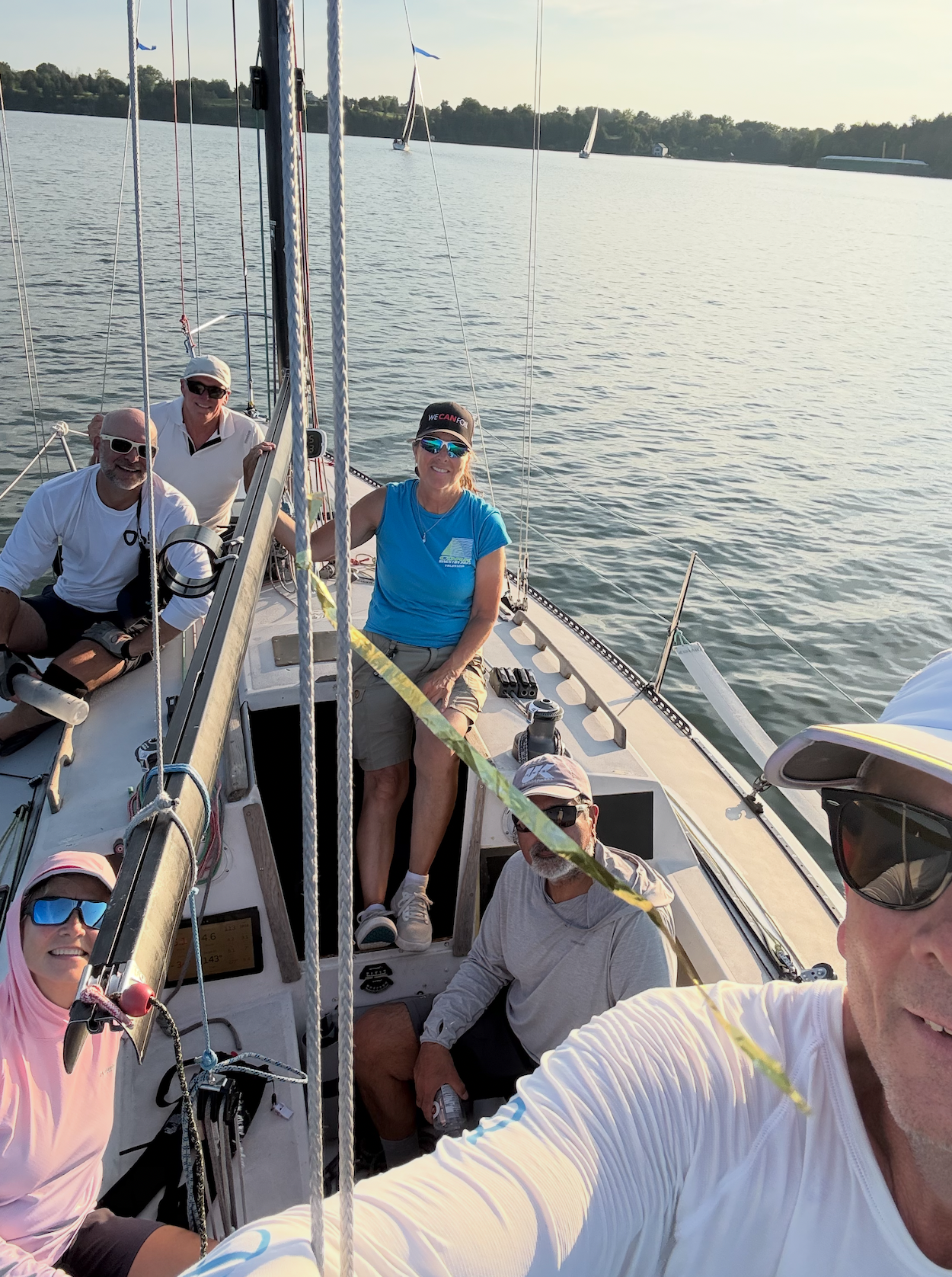
Crew
| Position | Person |
|---|---|
| Helm | Lynn Ellwood |
| Main | Sue Fraser |
| Middle 1 | Steve Ellwood |
| Middle 2 | Anik Karimjee |
| Mast | Joel Massicotte |
| Bow | Howard Whittaker |
Course
J2 - Simple 1nm Windward / Leeward, start line in the middle of the course.
Twice around.
Race shortened to finish on the last leeward (downwind) leg - no final upwind finish.
Weather
Sunny and warm. Around 6 knots, peaking at 9. 5 knots then 3 then zero, then backup to 4 knots. Picton Bay.
Race Result
3rd in the race but not unhappy.
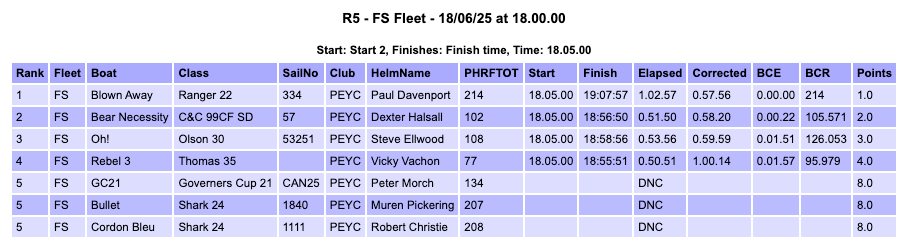
We did win the series!
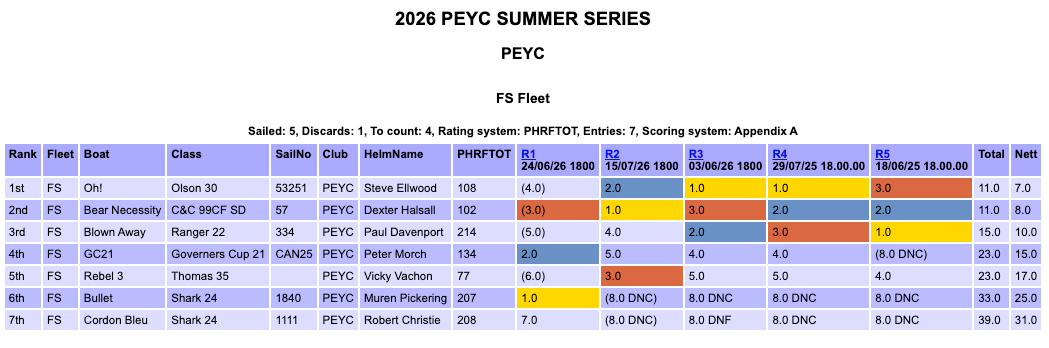
Blown Away was getting crushed. So Paul told me last night that he just decided to go on a flyer - I’m not sure where. But where ever it was he didn’t suffer from the zero wind pain nearly as much as everyone else. Way to go Paul Davenport!
Race Review
How we did in this race would determine if we won the summer series or not. We needed to be at worse one boat (on corrected time) behind Bear - but not more.
So Wednesday afternoon Lynn and I got out the scrub brush and we cleaned the bottom of Oh! right down to the bottom of the keel. Commitment.
Once out on the water, we spent a lot of time considering which side was favoured. We tested theories. We discussed what we were seeing.
It all made a difference.
The call was to start near the boat, perhaps with no one above us, and sail to the eastern side until the pressure eased. Then flip over.
Sue and Lynn ran the start. Sue placed Lynn in a position to make a close reach approach, three or four times, each time they judged whether they had chosen the right spot. Come race time the spot was right.
We were in front of Bear and Rebel returning to the line. All was well, except that the GC21 came in under us and attempted to force us up - and we were a bit early. We slowed down. We pinched up.
We couldn’t get up high enough to prevent Bear from getting between us and the RC - and still maintain some speed.
We relied on the Velocitek to tell us where the start line was - and we went for it. It felt like we were over, but we had confidence because we tested the line using the Velocitek several times pre-start. Howard was excellent calling the reported distance to the line, the time and the course. Information is power.
At go we ended up sailing right over top of the GC. And we were higher and faster than Bear - burning them off. Once again Rebel was on Bear’s tail and so Bear had to burn them off too.
Bear tacks away and we held course.
We were into the corner - almost - before flipping over.
All evening our tacks were a thing of beauty. Lynn was hitting her marks. And the big gennie ran clear and the Howard and Joel grabbed it and dragged it around like it was on fire. That made all the difference.
That, and Sue’s suggestion to drop the jib sheets into the cabin and just let them be there. They came out clean and no one had the opportunity to stand on them.
We had a thin lay line (we tacked a little early because the Tanzer 22 was on the line we wanted and we’d have to duck them otherwise). Lynn went to leeward side to steer with a view of the mark.
Sue and John’s Nonsuch were in front of us - in our way ;-( but happily we were able to climb up and around them.
The spinnaker went up a little sloppy but not terrible. It seemed we had a problem getting it to fill - which I think was Lynn sailing a little low.
Howard flew the chute. Sue and I trimmed the main and we worked our way through the fleet of Non-Flying Sails boats, pretty quickly.
We had Bear and Rebel behind us.
As we reached the leeward mark we had everyone behind us - except Lickety but even that was only a boat length. Read that again - we CAUGHT Lickety, after less than one full go around of the course and they had a 5-minute head start.
We did a great rounding in decreasing pressure. We were above Lickety’s line and we were moving - until we weren’t.
The wind shut off. Stopped, nothing - oxygen masks fell from the ceiling.
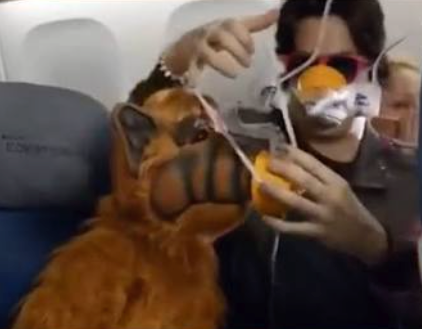
We were in a hole. Queue the echo.
And the rest of the fleet was compressing and catching us.
We saw the little bit of breeze indicate a tack and we took it - Lickety didn’t. But before we got settled the wind came back around and … we had to tack back - damn.
At that point Shannon Coull in True North rolled right up on us AND OVER US like we were standing still. Her jib was FULL ON back winding.
Then the CS30 Lorieli did the same thing - right over top of us. We were looking longingly at our sailing knives and contemplating ritual suicide - or at least I was.
But nothing lasts forever. Just before forever arrived the wind gently filled in and we started to move again.
Shannon tacked off to stbd and headed east. We held and slowly started moving and caught Lorieli, then sailed well above her.
Bear and Rebel, by staying low, got the incoming new wind well before we did and so they were gone.
It looked like, by being out in front, we showed the fleet where NOT to go once they rounded the leeward mark. That’s what happens, its nice to be a public benefactor.
Meanwhile, as the wind filled in for us, ok filled is in wrong - 3-4 knots is not paradise on earth. But we were moving again and Shannon, who tacked away, didn’t get that new breeze and we were suddenly 20 or more boat lengths in front of her.
We got close to the RC as we went upwind - another Picton Bay rule - ‘don’t trust Martin’ - to see if he was shortening the course on this leg - he wasn’t.
He did signal the course would be shortened and he even used the VHF radio to announce it. A christmas miracle.
We got up to the windward mark having regained much of the loss - not all, Lickety, Bear and Rebel were still in front of us.
We did a fine rounding and hoisted the chute. It was short and we were tempted to head for the line right away but applying past lessons we kept it hot in light air, we followed the polar true wind angle directions and we made up even more ground.
We gybed and as we approached the line we were close reaching to make the pin as the wind filled in.
This new breeze didn’t help us, we crossed and we were done. But the rest of the fleet now had breeze and it was reaching breeze - much faster.
That explains why Paul on the Ranger 22 Blown Away won. He was off in the corner, got new fresh breeze that allowed him to reach - god bless him.
We sailed well, we sailed fast, and, where the wind gods were not actively trying to sabotage us, we sailed smart. The boat is feeling fast and the crew work is terrific.
Thank you Oh! Team for a great evening on the water.
Lessons Learned
Ya Sail with the Wind that Brung Ya
The wind gods giveth, and the wind gods taketh away. Live with it.

Focus
Constant vigilance in the price we have to pay to succeed. We were all 100% focused on the wind, the sail trim, the boat balance, the boats around us.
Being mentally dialled in together is like a super power.
Constant Trimming
Here it is again, and again. A few ticks out on the jib and then, as the breeze increases slightly, a few clicks in.
Watch the upper spreaders. Upwind the sail should be 1” off the spreaders at most for best angle upwind. But when and increase in the wind pressure stretches the sail a little and changes that 1” to 3” or in a lull -2” (wrapping the sail around the spreader) - so watch it all the time - when you can afford a body on the low side.
I was running the jib and I could see the speed we got when these constant adjustments were made.
The main is the same, traveller, backstay, mainsheet (tight tight mainsheet most of the time), in and out, tweak tweak tweak.
The spinnaker, no surprise, the same. We were sailing with more luff curl than normal, allowing the spinnaker’s leading edge to curl more - the break. We saw this sailing with Gavin, a young Wasp sailor from Hawaii who sailed with us on the RS21 the night before. That experience reminded me - yes that’s how I learned it. A spinnaker can SO EASILY be over-sheeted. Out out out! Let it come near to collapse then bring it in. Sail it on the edge. That’s fast.
Draggers Tacking
This is huge. First Sue suggested the jib sheets should be tossed into the cabin - no foot cleats, no tangles. It worked a charm. Then Howard and Joel grabbed the sail as it came around and using their bodies dragged the clew kicking and screaming aft. If the sheet was not caught up - tough - the sail was around and ready. If the sheet was jammed they could call for it to be cleared well before the sail itself was constrained. In the past we would use the jib sheet to drag the sail around and if the jib sheet was struck we were the LAST to know and the sail stoped moving. Having the clew dragged around meant the draggers knew the sheet wasn’t clear seconds before we had a problem. Awesome.
Marks
This we learned, or rather were reminded of, on the RS21. In the RS21 getting the jib trimmed is pretty easy - pull. No winches, just pull. But pull too hard and you have folded the leech of the jib against the lower shrouds.
A leech that has a 2” hunk of sail cloth at right angles to the center line of the boat is … SLOW.
But when the jib trimmer trims they can’t see the leech. When should the pulling of the sheet be ‘done’?
So what we did was mark the jib sheet with a hunk of tape - this far in and no farther.
Its tape, it is there for the race, one race, is set to the conditions every time, to the size of the knots attaching the sheets to the jibs, to the fairleds, its going to be different every time.
So pre-race, every race, decide where the tape goes. This mark is a guideline. I found on the RS21 I was hauling in to about 2” before the tape marker after the tack - leaving the jib a titch eased out to get the boat up to speed before I brought it in 100% to the mark. No fear of over-sheeting, no fear of random results.
The Olson can use the same idea.
There are some settings that are absolutes, some are variable.
- Is the spinnaker 100% up? If yes then the MARK will be just above the spinlock jammer.
- Is the #3, #2, #1, halyard set tight enough? Check the makers - for these we need colours or numbers since the right hoist base line will vary by the sail hoisted.
- Baseline for the boom vang to get back to a good upwind setting? Tape mark.
- Baseline for the main cunningham - Tape mark
- Baseline for backstay - tape mark on the backstay itself (the trim line is too variable).
- The set for the pole down and pole up before the pole is set - how? Let the lines, pole up and pole down, out, say 3”, before the marks. Then draw them in to the marks when its up. This works for the pole height in play on the day. We have to have a little think about how to effectively do that. We are right now thinking about marks on the deck like a ruler and a black band on the line.
- Jib Sheets are tricky - where should the marks be? Best on the line itself because the trimmer is grinding and needs a reference they can easily see. We might try tape here and the tape may, may, survive. If not we will work out some system involving a ruler system between the fairlead and the turning block.
So this Saturday we will be heavily armed with sharpies, rulers, and many colours of tape. Good times!
Comments
Name and email required; comments appear once Steve approves them.