Creation: 260827 0508 Last Modified: 260827 0508
Crew
| Position | Person |
|---|---|
| Helm | Lynn Ellwood |
| Main | Sue Fraser |
| Middle 1 | Steve Ellwood |
| Middle 2 | Anik Karimjee |
| Mast | John (Howard’s friend) |
| Bow | Howard Whittaker |
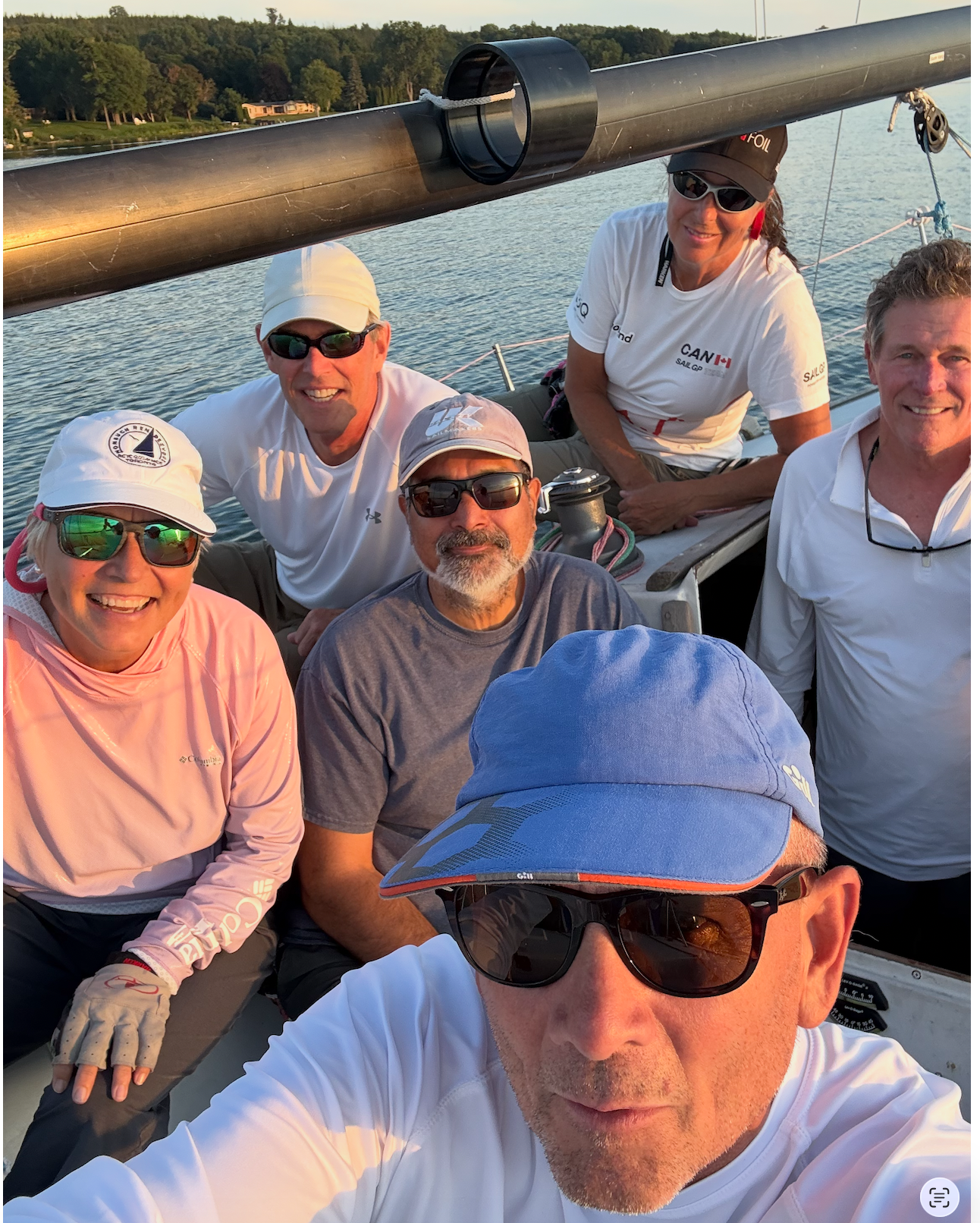 |
John made a real contribution working with Howard on the bow. Thanks for coming out John!
Course
J3 - three times around, floating orange marks.
The wind started at #1 and as predicted moved to #2 early in the race and stayed there.
Maybe those eagle-eyed readers among you can see this isn’t a Windward/Leeward race course.
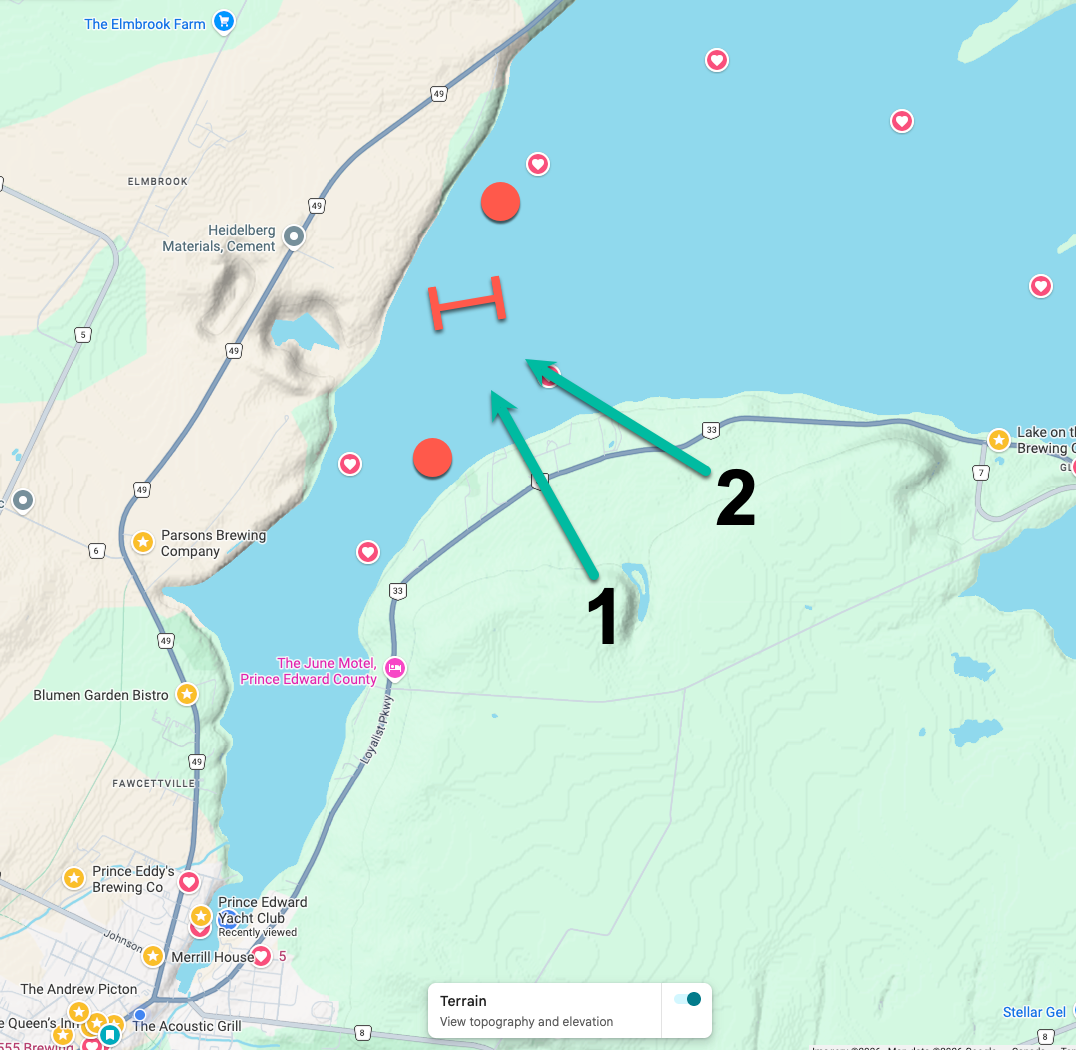
Getting a race off was Martin’s primary objective. He did AP twice, weirdly before the time to start the race but never mind that. But the course was simply no good given conditions and should have been not set in this way in the first place - given the consistent across models weather forecast.
Weather
Sunny skies and warm.
On the way out we saw 10 knots but it was mostly 5-8 from the south, 180ish.
Every weather model had the wind moving left from the widest range of 180 to 130 between 1800-2000 and softening to 4 knots - spoiler - that’s what it did.
Race Result
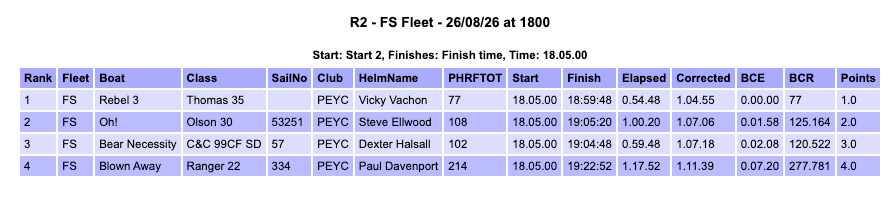
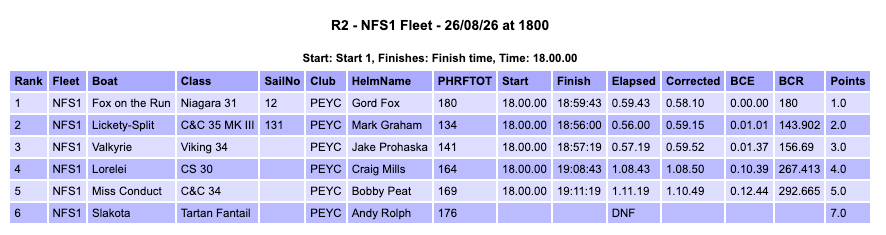
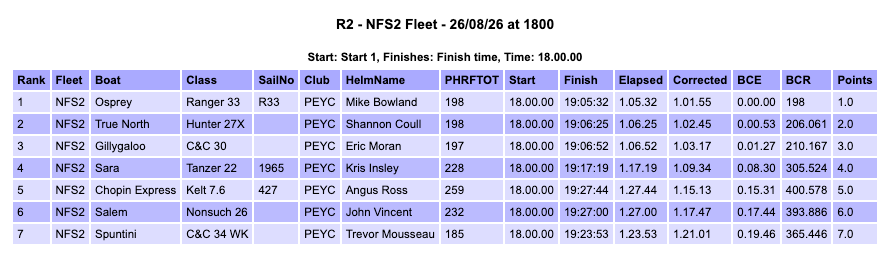
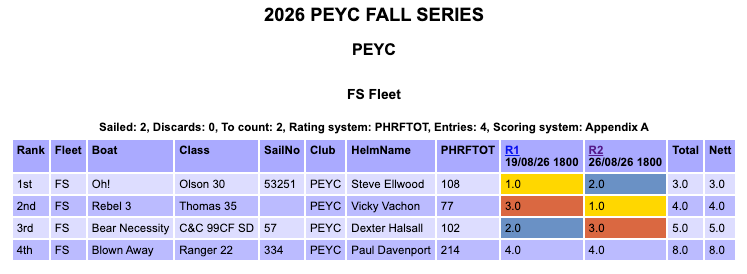
2nd place in our division, of 4. Rebel, Bear, Fox, Lickety and Valkrie ALL had significantly faster ACTUAL times around the course than we did.
Only Bear fell behind in corrected time. And we just squeaked in front, on corrected, of Lorelei.
Race Review
The course graphic above indicates the move was from say 160 to 130 ish ish.
It also shows the track Martin set was terrible.
Before the start he attempted to correct and moved the windward mark from the western shore over to the eastern shore - he made a profoundly bad course a *little less terrible.
Start
The line could not be crossed on starboard, so Martin AP’d and moved the boat ahead, well ahead. And the result…you still couldn’t cross the line on starboard.
Non-Flying sails started first. Lickety approached the pin with speed but at 30 seconds to the gun they realized they were too fast so they flogged their sails and slowed down, a little twisty turny driving and they burned off the speed.
At go they were not yet up to speed but they we moving at say 3/4’s. Didn’t matter, the rest of the white sail fleet was languishing. Osprey, the Ranger 33 driven by Mike Bowland, did a full on Vanderbilt start crossing the line at full rolling speed but 15 seconds late - he was the next best start.
Some, like Lorilei, didn’t cross for at least a minute after the start, other even longer.
It seemed the port start reaching start is unfamilar to the fleet and generated a lot of confusion.
Lynn and Sue ran our the start. We took what we saw and what we learned from Lickety. Of course so did the other 3 boats in our fleet.
This was a ONE TACK leg. From the start line to the weather mark, no tacking once you started. But could you fetch it if you started near the boat - maybe?
And if you were closer to the RC boat your breeze would be effected by the windward boats near the pin.
The uncertainty and wind issues drove all of us to start near the pin.
We lead Bear back to the line around 40 seconds. Slowly, slowly. We too had to burn off speed. They were closer to the pin. We were below them in their disturbed air.
At go we were cross the line at mid-speed but we were stuck in their bad air.
Meanwhile, Rebel was quite late to the line, they were doing a poorly timed vanderbilt start. But they came charging through with speed, they rolled us and decided to play silly buggers with Bear. Bear wasn’t having it.
It was nice to see them distract each other.
First Leg
As the speed came on our apparent wind angle moved forward. Reach became close reach. Puffs generated the same effect, moving the apparent wind forward. Lull’s moved it back.
It was a night of constant jib trim.
The leg was short so we had no time to catch the white sail fleet before the mark, which mean we had to pass through a cloud of starboard tackers coming at us as we approached the windward mark.
1st “Windward” Mark
Bear and Rebel had settled their differences - in Bear’s favour - and both rounded the mark in front of us. They were closer to the wind and had less/no disturbed air to deal with except form each other.
As we approached the windward mark on port Salem, John Vincent’s Nonsuch 26 was coming in on starboard. Happily is was parked about 5 boat lengths from the mark, so not an issue. But Angus in his Edel 22 took the mark wide and close, leaving no room for us to sweep around inside him and roll him.
Rebel was ahead of us, just, and they too had to drop around the outside of Angus.
It was here that duties got confused - my fault.
We have established that we communicate, and we communicate and when that fails, we communicate. Lots of input.
But the input isn’t waiting for a vote. We designate a ‘decider’. That person is in charge of taking in the input and making a decision - they giving instructions to the team.
So two parts - ideas and actions.

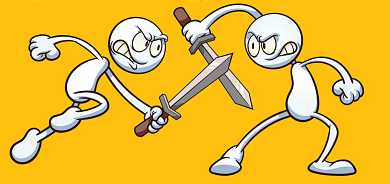
The ideas come from everyone, and the direction to action comes from the decider.
The set up works well except for me. I was the decider last night, I am almost always the decider on Oh!. I have found that Lynn and Sue have consistently executed great starts all season long when Sue directs Lynn - with me out of the second to second loop. As decider I offer the framework 90-180 seconds before the start around which side of the course I want to take and we agree on what end of the line that needs etc. Then, its their show - and they do a great job - consistently.
For the start Sue necessarily has to be the decider - the one giving Lynn direct ‘turn now’ instructions - no debate its her call.
My mistake was not taking the decider role back in my hands after the start.
Everyone else was following the program but I left a gap.
So we come into the windward mark, Angus tight and turning, Rebel turning around Angus - and us.
Angus was in the circle first, Rebel was in the circle next then us - we owed everyone room. Happily John’s Nonsuch wasn’t also jammed in the mix.
The right thing to do was being called by Sue - take Rebel’s transom and follow them around. Right because we can’t go inside Angus, we can’t flip inside Rebel because they will put us in a race ending sandwich where we have no rights and can’t go up - protest. Don’t go in there…
I saw Rebel didn’t execute their turn properly. They left too much room between themselves and Angus. There was a hole they couldn’t object to us taking. Nice…
But I didn’t give direction fast enough. I didn’t seize the reins as was my job.
As it was we did turn and squeeze in between Angus and Rebel but quite late. If Rebel was on the ball they could have protested us, but the weren’t - just lucky I guess.
We got under Angus and away. Rebel was pinwheels to the east to weather wide. On reflection my thinking was impacted (and in telling this long fact challenged tale it seems to remain impacted) - around the structure of a real windward leeward race - not a reach race.
Rebel’s wide turn put them upwind - weather boat. Big sail plan - blanketing the air for Angus and us.
No escape for us but to wait for them to pass.
Their rig is much much taller than ours.
So their perceived blundering (which - looking at their crew work - was not a cleverly planned strategy) actually put them in a great position over the boats they went around with.
They took off, Bear was gone, and we took up the rear - us and Angus…
In retrospect I think the right answer was to pass on the outside of Rebel and turn on top of them - to windward for the next leg.

1st “Leeward” Leg
The reach was tight but we thought we could carry the chute. Our two playmates Bear and Rebel were rigged and in preparation to hoist as well. All three of us did.
It was tight. In fact as the spinnaker did its work, the apparent came forward and we couldn’t carry an more. So we dropped below the rhumb line.
My thinking was that we carry the chute with speed low of the leeward mark for as long as we can. We would then drop and use the gennie in a close reach to regain the rhumb line and round the mark on the inside. Seemed like a good plan.
The white sail fleet - those boats that got around the course in a shorter elapsed time that we did? - ya those folks - they turned at the mark and pointed their bows at the leeward mark and opened a beer.
Our efforts came to naught. The chute, were we to carry it, should have been the asym (which is in the garage and not on board - another head slap). But even that sail couldn’t point high enough to overcome the apparent wind angle that the speed it gave would generate.
Note Lickety, white only, compared to Rebel around the course - doing nothing but pointing the bow and drinking beer - was only slower around the course than Rebel in uncorrected absolute elapsed time by 1 minute 12 seconds. In a 1 hour race.
Again in my mind I was thinking windward/leeward. Get downwind fast - nope that wasn’t last night’s game.
Last night was stay above the competition to keep your air clear, use your gennie in reaching mode and focus on sail trim.
All the disruption of the spinnaker set, douse and trimming problems - only slowed us down.
Once we gave up the spinnaker and changed to the outer fairlead for the jib sheets our speed improved.
As the Race Progressed
We caught up to Bear. Rebel, staying high, had managed to catch and pass Bear. Bear rounded the “leeward” in front of us but only ‘bearly’.
They owed us time on PHRF. We don’t have to be in front of them to beat them. This is another mind set that crashes into half a life time of one design racing. How do I get past them, I can go faster…
There is something about the two people being chased by a lion. One says to the other, How can we out run the lion? The other says, I don’ need to outrun the lion - I only need to out run YOU.
The question is what is winning.
In PHRF being on Bear’s tail within a few boat lengths - 20 seconds or so - on this course with this wind - beats them.
We were 12 seconds behind at the finish and beat them by 10 seconds corrected. So we had 22 seconds for a tie.
Our correct play was to simply keep our air clear by staying slightly, slightly above them, and not try to overtake them to weather - or break through their lee. Just follow along like an annoying sibling. Slowing down if we were catching them. Always just behind them.
We were half a boat length behind on their transom. They couldn’t shake us. With our mental model reset for reach/reach sailing and our sails sheeted outboard, we were as fast or faster then they were.
But the one-design demon was sitting heavily on our shoulder.
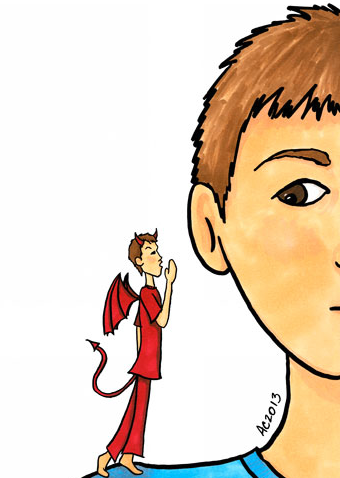
We took the low rode and decided to reach down toward the boat-ish end of the finish line.
Nah - that didn’t work.
We went back to our following, but from lower and slower. Luckily we survived.
Lessons Learned
Are we on a Windward/Leeward Course?
If not, the mindset has to change. Every ingrained instinct about what to do next, where to position the boat on the course, sail trim, everything we trust - needs to be re-evaluated - perhaps with a piece of paper and pencil to get it through (my head) that this time its different.
On a distance race we can do that easily and naturally. But around the cans - it was tough to make the change - and it cost us.
Set the fairleads outboard early and often
We sailed 3.5 of the 6 close reaching legs, (those 6 close reaching legs being the whole race) of this course with the jib sheet fairleads set as though we were going max upwind.
It was on close reach leg 3.5 when I realized I didn’t need to protect against the possibility of a tight close hauled situation. And we finally changed to the outer fairleads for the jib sheets.
I could have run two sets of sheets - we have then at hand. But instead we simply dragged the windward sheet around and it replaced the inboard active sheet after we ran it though the outer fairlead.
The result? Better sail shape, better trimming angle, better speed.
So have the extra set of sheets rigged - run them through the outer fairleads and tie them to the stanchions on either side - waiting for their chance to shine - no reason not to.
Decider
I have to re-engage after the start in my role as decider - if that’s the role I have that day.
I think jib trim should have gone to Anik all the time - my taking over that job was distracting and occupied the few available brain cells I have - making the looking around part secondary.
PHRF Victory is NOT First Cross the Line
Our ideas and actions have to flow from a framework of faster is better, of course. But our strategy is to be focused on winning the race - getting the bullet.
In PHRF, a close following position of a boat that owes us time beats them. No fighting, no fuss, no risk - we need to make Sun Tsu proud.
Comments
Name and email required; comments appear once Steve approves them.